Between Tradition and Modernity: The High Holy Days Melodies of Minhag Ashkenaz According to Ḥazzan Maier Levi of Esslingen. Geoffrey Goldberg. Jerusalem: Jewish Music Research Centre – Hebrew University of Jerusalem. 2019.

Reviewed by Marsha Bryan Edelman

Ethnomusicologist Abraham Zvi Idelsohn (1882-1938) put the study of Jewish music on the scholarly map with the publication of his 10-volume Thesaurus of Hebrew Oriental Melodies (Leipzig: Breitkopf & Härtel et al., 1914–32). Long considered an authoritative resource, Idelsohn’s work has come under some scrutiny by more recent research and by the discovery of additional materials that complement, and occasionally contradict, Idelsohn’s conclusions. The Yuval Music Series, launched by the Jewish Music Research Centre at the Hebrew University of Jerusalem in 1989, has endeavored to provide a sequel to Idelsohn’s research. Geoffrey Goldberg’s Between Tradition and Modernity: The High Holy Day Melodies of Minhag Ashkenaz according to Hazzan Maier Levi of Esslingen is Volume 12 in the Yuval Series, and a most worthy contribution.

Maier Levi (1813 – 1874) is not a well-known name in the history of cantorial music, nor was Esslingen a major center of Jewish life. What makes the present work so valuable is that Levi served as a teacher of hazzanut and prepared his compendium as a study tool for his students at the Esslingen Teachers Seminary from which Levi had also graduated, although at the time, training in hazzanut was very limited; Levi enhanced his own cantorial knowledge through private study with other local hazzanim. In addition to providing details about Levi’s life and career, Goldberg also recounts the history of the types of training available to nineteenth-century hazzanim in Germany (only some of which Levi himself experienced). The key takeaway from this historical background is that Levi lived and taught at a pivotal moment brought about through the Emancipation of German Jewry (1848) and the aesthetic revisionism of the emerging Reform movement (1819). His compendium, completed over the course of many years (1845-late 1860s) thus reflects the changing musical styles Levi and his students would have experienced, and his notations reflect the evolution from “old-world,” often highly embellished tunes, to the more “modern” and unadorned chants in vogue during his later years.

Read the rest of this entry »

“Ya Shema Evoynecha,” performed by Carla Berg, original poem in Hebrew by Yehuda Halevi, Ladino lyrics by Rabbi Reuven Eliyahu Yisrael, uploaded September 15, 2022, https://www.youtube.com/watch?v=v2QlJLkgeZw.

Reviewed by Lealiza Lee

The piyyut “Ya Shema Evoyonecha,” by Yehuda Halevi, is most widely known as a component of the Sephardic selichot service. Carla Berg is a vocalist who brings to light a long-forgotten Ladino version of the piyyut in a recording released for Rosh-Hashana.

Read the rest of this entry »

Recording History: Jews, Muslims, and Music across Twentieth-Century North Africa. Christopher Silver. Stanford, CA: Stanford University Press. 2022.

Reviewed by Hugo Hadji

In Recording History: Jews, Muslims, and Music across Twentieth-Century North Africa, Christopher Silver provides the first in-depth and comprehensive history of the North African music recording industry and scene from the dawn of the twentieth century to the early post-independence era. Guided by the premise that music and history are mutually constitutive, Silver offers to listen to the sounds and artists that shaped and reflected the identities of Jews and Muslims living in the Maghreb region during that period. Such work, Silver convincingly argues, “provides twentieth-century North Africa with a soundscape that dramatically alters its historiographical landscape” (13) and allows us to use music to explore Jewish-Muslim relationships, coexistence, and subjectivities outside of and challenging the typical frameworks of “majority-minority” power relations and the mass departure of Jews in the 1950s and 1960s dominant in the literature. It further allows us to acknowledge and recount the central place Jews held in the construction and development of the recording industry and popular musical scene in North Africa, as artists and as intermediaries. 

Read the rest of this entry »

Jerusalem: Blake, Parry, and the Fight for Englishness. Jason Whittaker. Oxford, UK: Oxford University Press. 2022.

Reviewed by Benjamin Wolf

This is a book about a single poem and a single song: William Blake’s poem, Jerusalem (“And did those feet in ancient time walk upon England’s mountains green”), and Hubert Parry’s famous setting of it. This combination of words and music has been central to British (perhaps it is better to say English) cultural life since Parry’s composition was first performed in 1916. Although originally composed for “Fight for Right,” an organization that supported Britain’s war efforts, it was subsequently adopted by the women’s suffrage movement, the Women’s Institute, and by figures on both the left and right of the political spectrum. Jason Whittaker traces this history, and the possible cultural meanings of both Blake’s poem and Parry’s setting of it, over a two-hundred-year period, ending in the Britain of the 2011 royal wedding, the 2012 Olympic Games and the 2016 Brexit referendum. Where British musical history is concerned, this book takes a valuable place alongside others such as Andrew Blake’s The Land without Music or Hughes and Stradling’s more cynical The English Musical Renaissance 1840 – 1940. [1]

Read the rest of this entry »

Let Our Music Be Played: Italian Jewish Musicians and Composers under Fascism. Edited by Alessandro Carrieri and Annalisa Capristo. Cham, Switzerland: Palgrave Macmillan. 2021.

Reviewed by Jesse Rosenberg

The last twenty years have witnessed significant developments in scholarship concerning antisemitism in Italy during the ventennio, the twenty-year period of Fascist rule (1923-1943). Thanks to historians such as Michele Sarfatti and Giorgio Fabre, the benign view which had hitherto prevailed with regard to the antisemitic laws promulgated by the Fascist government in 1938 — that these were adapted without conviction, in adherence to the dictates of a new alliance with Germany, and represented an unexpected about-face in the treatment of Italian Jews — have been definitively rebutted. The editors of this superlative collection of essays are aware of these newly-acquired insights (one of them, Annalisa Capristo, has co-authored an important book with Fabre), but also, to judge by the variety of approaches taken by the contributors to the book, equally cognizant of the complexities involved in applying these lessons to the field of music.

Read the rest of this entry »

Sonic Ruins of Modernity: Judeo-Spanish Folksongs Today. Edwin Seroussi. London: Routledge. 2023.

Reviewed by Lori Sen

A minority within the Jewish people, Sephardim are a triple diasporic population, who carried with them their culture, traditions, language (Judeo-Spanish), and oral literature. Judeo-Spanish folksongs are among the Sephardim’s oral literature and reflect the diverse influences of the many cultures they encountered throughout their five-hundred-year-long journey from medieval Iberia to all over the modern world. With Sonic Ruins of Modernity, musicologist Edwin Seroussi introduces the contemporary concept of folksong (in the post-tradition era) as a sonic ruin, regularly visited by tourists interested in exploring the history of other cultures.

Read the rest of this entry »

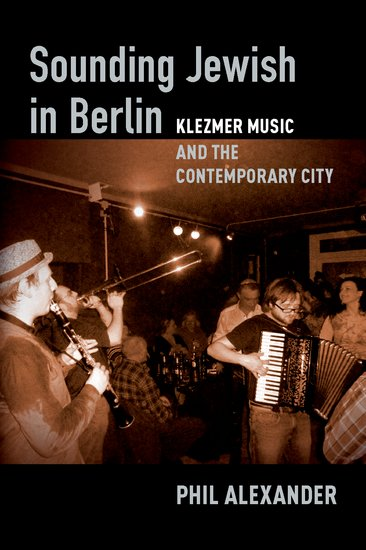
Sounding Jewish in Berlin: Klezmer Music and the Contemporary City. Phil Alexander. Oxford: Oxford University Press. 2021.

Reviewed by Zeke Levine

For the past two centuries, Berlin has maintained its role as a central crossroads of global politics, culture, and geography. The German capital is the focus of Phil Alexander’s Sounding Jewish in Berlin. Alexander probes the lively, yet complex contemporary Berlin klezmer scene, delving deeply into the ideological and aesthetic issues that shape it. While the klezmer revival has its roots in the United States, Alexander effectively and engagingly transports the reader to Berlin, an important locus for klezmer performance since the 1980s. Berlin, notes Alexander, is a complex setting for klezmer, given the city’s conflicted relationship with Jewish, particularly Eastern European Jewish, communities and folkways. Throughout the text, Alexander highlights thirty musicians and other creatives on the Berlin scene, framing the book around their experiences as well as his own extensive ethnographic experience as both a performer in, and keen observer of, the scene.

Read the rest of this entry »

Jewishness, Jewish Identity and Music Culture in 19th-Century Europe. Ed. by Luca Lévi Sala. Bologna: Ut Orpheus. 2020.

Reviewed by Martha Stellmacher

The Enlightenment and the granting of civil rights to Jews in nineteenth-century Europe opened up new opportunities in society, and also in cultural and musical life. These processes were accompanied and reflected in the ongoing discussion of the so-called “Jewish question,” a debate in Jewish and non-Jewish circles concerning the understanding of Judaism and the status of Jews in the European societies. Though from the second half of the 19th century this term was increasingly used in antisemitic circles and finally taken up by the Nazis, it originally referred to a broad discussion on the political, national and legal position of a Jewish minority in a non-Jewish majority society. It partly touches in its nature upon aspects that we would call today “identity” —a term frequently used in the past decades to examine questions of belonging and self-understanding. Sala’s book assembles eleven studies touching upon many different aspects and layers of Jewish identity in the 19th century. These studies include the individual Jewish identity of certain composers and the expression of Jewish identity through music works up to the perception of Jews and Judaism by the gentile world.

Read the rest of this entry »

Eastern Mediterranean Judeo-Spanish Songs from the EMI Archive Trust (1907-1912). Rivka Havassy and Edwin Seroussi. Jerusalem: Jewish Music Research Center, Hebrew University of Jerusalem. 2020.

Reviewed by Vanessa Paloma Elbaz

The EMI Archive Trust houses a collection of Jewish music from the Eastern Sephardim, originally released by Gramophone and Zonophone on 78 RPM between 1907 and 1912. This collection was released by the Jewish Music Research Center as a recording, with a physical CD and an online presence, including liner notes in English and Hebrew, song texts and their translations providing a wealth of material for this review. The collection includes songs in Judeo-Spanish, Hebrew, Turkish and Serbo-Croatian. Ladino selections are numerous, demonstrating the public presence of Ladino in Ottoman urban centers of this area at the time, despite the minority status of its community. The confluence of “the predominantly urban character of the late Ottoman Jewish society and its increasing middle class aspirations and leaning towards Westernization during the last decades of the Empire, coupled with the Jewish ethnicity of some key managerial figures of the European record companies, contributed to the presence of the song in Ladino in the early Eastern Mediterranean discography” (11-12). As was also the case with early Judeo-Arabic recordings, Jewish producers almost monopolized positions of local representation for international recording companies. This may have been partially due to the legacy of the Alliance Israelite Universelle’s training in French for Mediterranean Jews since the nineteenth century, which facilitated exchange and collaboration with European companies by the early twentieth century. Such collaboration allowed local musicians to create a dynamic market for the recording of Jewish artists and repertoires throughout the Ottoman empire and North Africa as recording technologies were developed and monetized. Another release (from 2008) from the JMRC in this broad category is focuses on Odeon’s recordings of Haim Effendi from 1907 in Turkey.

Read the rest of this entry »

Musical Exodus: Al-Andalus and its Jewish Diasporas. Ruth Davis. Lanham MD: Rowman & Littlefield. 2015.

Reviewed by Samuel Torjman Thomas

The Iberian Peninsula has served as a focal point for enhancing our understanding of early modern racism, the age of nautical exploration, migration, memory, the advent of European colonialism, and perhaps most intensely as the site of interreligious intersectionality between Muslims, Jews, and Christians and its consequences. The notion of diaspora has informed the work of many scholars in the modern academy. A topic of great interest in fields such as cultural anthropology and ethnomusicology, and even its own field, Diaspora Studies, diaspora has also long been a bedrock topic for Jewish studies. In this edited volume, Musical Exodus: Al-Andalus and its Jewish Diasporas, we find valuable contributions to discourses about Iberian history, Jewish culture, diaspora, and musical development.

Within this edited volume, we find a close analysis of the dynamics involved in several animating factors of the Sephardi diaspora, including schism, exile, mass emigration, resettlement, intraethnic synthesis, postmodernist imaginaries, and transnationalism. The title suggests a pluralization of the Sephardi diaspora, as an experience that perhaps informs an array of diasporas. We are encouraged to consider this community’s experience of collective identity development as multitudinal, touching several disparate geographical centers and moments on a timeline that stretches over five centuries. Through the included chapters and their focus on a field of expressive culture (music), we can better appreciate how the Jewish experience of diaspora involves much more than the reinforcement of some overarching and monolithic transnational community. We learn how the dynamics of the Jewish diaspora experience provide the necessary context for new transnational layers to emerge. While fraught on so many levels and in so many ways, these dynamics are reconceived in this book and represented as the location of the endurance of expressive culture. Music serves as the vehicle of choice here, as a means of navigating the emergence and realization of these new diasporic Jewish identities rooted in reproducing vibrant and vital connections to a Sephardi (Andalusian) homeland. [1]

Read the rest of this entry »