
You are currently browsing the tag archive for the ‘Sacred Music’ tag.
Singing the Land: Hebrew Music and Early Zionism in America. Eli Sperling. Ann Arbor, MI: University of Michigan Press. 2024.
Reviewed by Inbar Shifrin

To a Jewish American, which anthem would hold greater importance: “The Star-Spangled Banner” or “HaTikvah?” According to Eli Sperling’s book Singing the Land: Hebrew Music and Early Zionism in America, the answer is both. One anthem affirms American patriotism, while the other represents a connection to Israel. This complex example illustrates the central question Sperling seeks to answer in his book: How did Hebrew songs play a role in fostering Zionism and a yearning for the land of Israel within American Jews without encouraging immigration to physically build Israel?
Read the rest of this entry »The Cambridge Companion to Jewish Music. Edited by Joshua S. Walden. Cambridge: Cambridge University Press. 2015.
Reviewed by Simone Salmon

By creating and editing The Cambridge Companion to Jewish Music, Joshua Walden addresses the question, “What is Jewish Music?” This volume includes Biblical Music, Liturgical Music, Music in Judeo-Spanish, Klezmer, Yiddish Theater, Haskalahic Synagogue Music, European Art Music, and Israeli Art Music. The topics covered are ontology, diaspora, hybridity, separation from source, musical reform, identity negotiations, and bi-directionality. The works included span the ancient, modern, and contemporary periods. The book contains three main sections: conceptions of Jewish music; Jewish music in religious, folk, and popular contexts; and periods, places, and genres of Jewish music composition.
Read the rest of this entry »Golden Ages: Hasidic Singers and Cantorial Revival in the Digital Era. Jeremiah Lockwood. Berkeley and Los Angeles, CA: University of California Press. 2024.
Reviewed by Matthew Austerklein
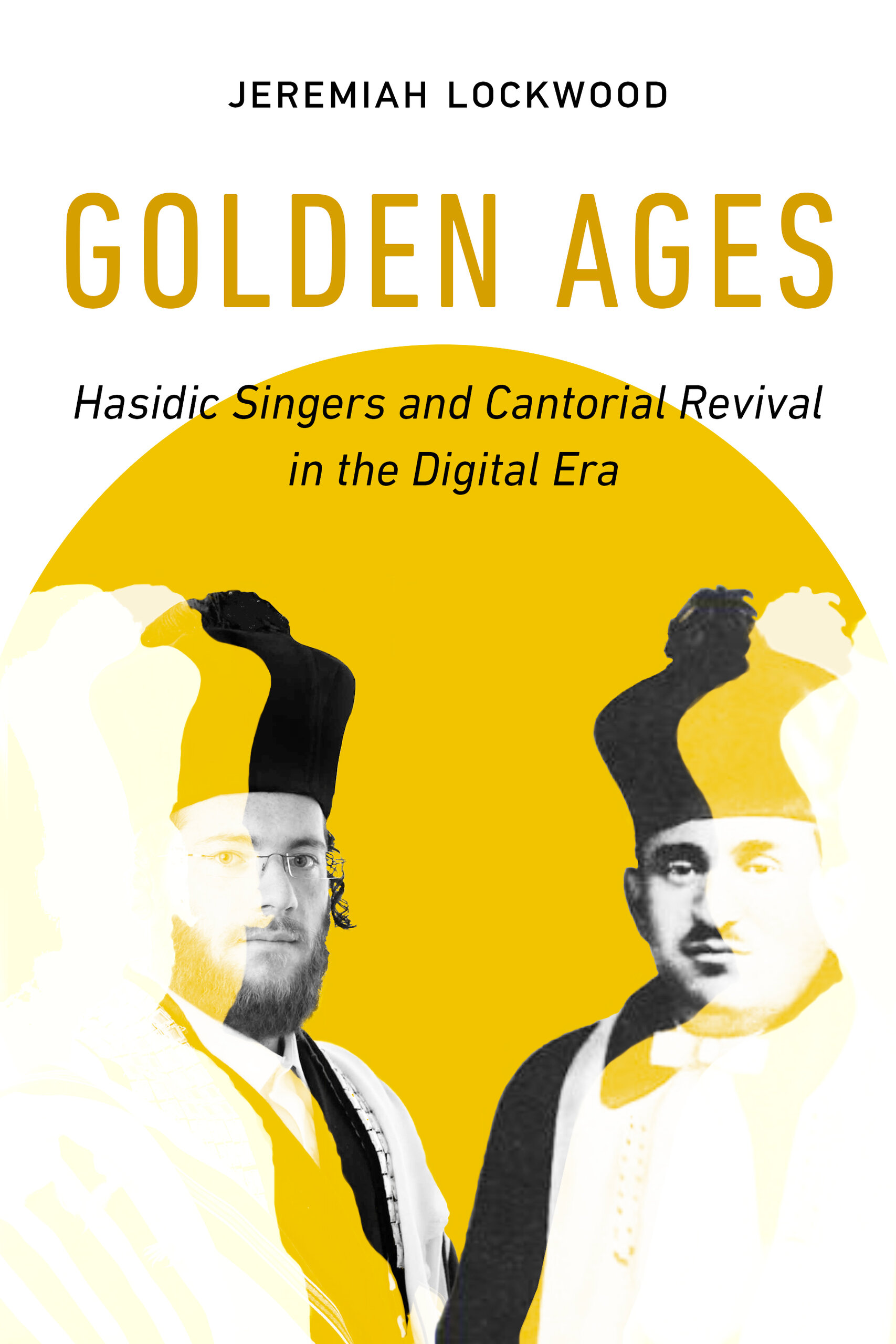
Jeremiah Lockwood’s new book, Golden Ages: Hasidic Singers & Cantorial Revival in the Digital Era (University of California Press, 2024) is the culminating work of a determined and thoughtful advocate of cantorial music. The grandson of Cantor Jacob Konigsberg, Lockwood is a scholar-activist with a long history of academic achievement and musical creativity [1]. This new work continues that trajectory, combining a thorough study of cantors with hints of an emerging musical ideology. At the center of his groundbreaking book are the stories of a small group of Hasidic singers in Brooklyn who are reviving Golden Age cantorial music through performance and recording, all while negotiating their countercultural love of this expressive art form within the skeptical world of Hasidic Judaism and the largely pop-music ethos of the Orthodox synagogues in which they serve.
Read the rest of this entry »City of Song: Music and the Making of Modern Jerusalem. Michael A. Figueroa. Oxford: Oxford University Press. 2022.
Reviewed by Tanya Sermer

Michael A. Figueroa’s captivating City of Song: Music and the Making of Modern Jerusalem is a book about Jerusalems—high/low, celestial/terrestrial, metaphorical/material—and how musical representations of the city have produced a multiplicity of political imaginaries about those Jerusalems in modernity. Combining an impressive array of interdisciplinary theory, historical and archival study, ethnographic fieldwork, and close listening to songs in Hebrew about the city, Figueroa creates a sophisticated framework for understanding how music and poetry (from the Psalms through Israeli popular song of the 1970s) have been used to create subjective and changing “spatial knowledge” about Jerusalem among Zionist Jews and Israelis over the course of the twentieth century. Presenting a remarkably nuanced exploration of the contested meanings inherent in cultural output regarding the city, Figueroa is deliberate in his relational approach to the people and spaces in his study; discussions of Jerusalem throughout the book consider the perspectives and concerns of Palestinian Arabs, Armenians, or ethnic and religious divisions within the Jewish and Israeli populations. Figueroa’s commitment to a relational approach—a growing body of such scholarship in musical studies of Israel and Palestine that aims to break down the mutual exclusion of those two national narratives as well as the conventional dichotomies within them—offers the reader a rich picture of the social and political forces at play and the greater implications of the territorial imaginaries that underpin the songs Figueroa examines.
Read the rest of this entry »Encyclopaedia of British Jewish Cantors, Chazanim, Ministers and Synagogue Musicians: Their History and Culture. Michael Jolles. London: Jolles Publications. 2021.
Reviewed by Judith S. Pinnolis

Without question, this monumental work of nearly 900 pages (and growing) is a vast achievement and watershed moment in the history of Jewish music in the United Kingdom. The volume gathers and documents a vast historical record in a single compendium. Historian Michael Jolles has created an unparalleled resource available to anyone with an internet connection. While supported by an editorial board, the work displays the views and perspective of a single individual, which Jolles has dubbed a “framework” for the study of British chazanim (the religious prayer leader), synagogue musicians, and institutions. The work also includes lists of rabbis, composers and others contributing to synagogue music. The detailed facts and figures collected represent an amalgamation from myriad archival and research resources into an organized collection. The volume is organized in two main parts. The first describes the roles of the various musicians of the synagogue and the attending historical and cultural backgrounds, which serve as introductory materials, and the second consists of a collection of biographical sketches of various lengths and depths, which date from names known as early as 1656 up to the present.
Read the rest of this entry »Between Tradition and Modernity: The High Holy Days Melodies of Minhag Ashkenaz According to Ḥazzan Maier Levi of Esslingen. Geoffrey Goldberg. Jerusalem: Jewish Music Research Centre – Hebrew University of Jerusalem. 2019.
Reviewed by Marsha Bryan Edelman

Ethnomusicologist Abraham Zvi Idelsohn (1882-1938) put the study of Jewish music on the scholarly map with the publication of his 10-volume Thesaurus of Hebrew Oriental Melodies (Leipzig: Breitkopf & Härtel et al., 1914–32). Long considered an authoritative resource, Idelsohn’s work has come under some scrutiny by more recent research and by the discovery of additional materials that complement, and occasionally contradict, Idelsohn’s conclusions. The Yuval Music Series, launched by the Jewish Music Research Centre at the Hebrew University of Jerusalem in 1989, has endeavored to provide a sequel to Idelsohn’s research. Geoffrey Goldberg’s Between Tradition and Modernity: The High Holy Day Melodies of Minhag Ashkenaz according to Hazzan Maier Levi of Esslingen is Volume 12 in the Yuval Series, and a most worthy contribution.
Maier Levi (1813 – 1874) is not a well-known name in the history of cantorial music, nor was Esslingen a major center of Jewish life. What makes the present work so valuable is that Levi served as a teacher of hazzanut and prepared his compendium as a study tool for his students at the Esslingen Teachers Seminary from which Levi had also graduated, although at the time, training in hazzanut was very limited; Levi enhanced his own cantorial knowledge through private study with other local hazzanim. In addition to providing details about Levi’s life and career, Goldberg also recounts the history of the types of training available to nineteenth-century hazzanim in Germany (only some of which Levi himself experienced). The key takeaway from this historical background is that Levi lived and taught at a pivotal moment brought about through the Emancipation of German Jewry (1848) and the aesthetic revisionism of the emerging Reform movement (1819). His compendium, completed over the course of many years (1845-late 1860s) thus reflects the changing musical styles Levi and his students would have experienced, and his notations reflect the evolution from “old-world,” often highly embellished tunes, to the more “modern” and unadorned chants in vogue during his later years.
Read the rest of this entry »A Fusion of Traditions: Liturgical Music in the Copenhagen Synagogue. Jane Mink Rossen and Uri Sharvit. Odense: University Press of Southern Denmark, 2006. 156 pp. + supplemental CD. ISBN 978-8-7767-4038-2
Reviewed by Andrew Buckser
Jewish liturgical music presents a wonderful example of the way that local traditions emerge out of historical and political processes. Its content and style are often deliberately traditionalist, aiming to connect contemporary listeners to a history stretching back to the days of the prophets. That history is a complex one, however, involving thousands of years of migration, factionalism, and local variation, each of which have left their traces in the ethnic and cultural composition of any Jewish community. A Jewish service, especially a holiday service, contains a number of distinct musical events, and each of these requires a choice among the musical traditions associated with the different elements of the local community. In the music of its liturgy, therefore, every congregation literally sings out the unique fusion of traditions that make up its distinctive history. Read the rest of this entry »
Jewish Music and Modernity. Philip V. Bohlman. New York: Oxford University Press/AMS Studies in Music, 2008. xxxiii + 280 pp. ISBN 978-0-1951-7832-6
Reviewed by Lisa Parkes
Discourse about “Jewish music” has traditionally raised complex questions about the identity of “Jewishness” in music. The ontology of “Jewish music” in modern Jewish history is as elusive as the nature of music itself. The reason for this, as Philip Bohlman argues in Jewish Music and Modernity, is that Jewish music in modernity exists not within a definable space or time, but rather at moments of disjuncture – in between regions, amid moments of transition and transformation, and at the border of ethnic, religious, and social boundaries. Jewish music, as an aesthetically autonomous object in Jewish society, was conceived of for the first time at the modernist moment, when Jews entered the public sphere of modern European society, broadening the purely ritualized devotional function that music formerly served. But the structural transformation that modernity brought about in musical culture had the paradoxical effect of confounding the very notion of “Jewish” music. Exposed to modern musical practices and genres in the non-Jewish public sphere during a period of political and aesthetic transformation, Jewish music became “Jewish” precisely in its confrontation with non-Jewish genres, forms, languages, and performers. Bohlman demonstrates that Jewish music, in responding to the political and aesthetic challenges of modernity, is inherently hybrid, unstable, and dynamic. It represents a dynamic site where national, ethnic, and gender identities are constructed and contested. Thus, borders between Jewish and non-Jewish became permeable, so that “musical repertories that for some were entirely Jewish—say, cabaret at the turn of the twentieth century—were not the least bit Jewish for others” (xvii). In other words, music participated in the transformation of modern Jewish identity itself.
Read the rest of this entry »
Maqam and Liturgy: Ritual, Music, and Aesthetics of Syrian Jews in Brooklyn. Mark L. Kligman. Detroit: Wayne State University Press, 2009. 267 pp. + CD. ISBN 978-0-8143-3216-0
Reviewed by Galeet Dardashti
During my public lecturing on Judeo-Arab liturgical music, I often play recordings. Invariably, after hearing the thoroughly Arab sounds—sounds that, for many attendees, evoke images of the Muslim muezzin’s call to prayer—someone in the audience asks, “What is Jewish about this music?” Mark Kligman artfully answers this question in his comprehensive study of the Judeo-Arab synthesis between the music and text of the Shabbat liturgy of Syrian Jews living in Brooklyn. The author endeavors to provide a descriptive analysis of the Sabbath liturgy as well as a cultural lens for understanding Syrian Jewish identity (11). The Aleppo Syrian Jews of both Brooklyn and Israel are known for their appreciation and punctilious maintenance of the Arab maqam—traditional Arabic music’s system of melodic modes—in their liturgy. While other studies have examined other aspects of Syrian Jewish liturgy, Kligman’s is the first to document and analyze Syrian musical practices in the Sabbath service. Read the rest of this entry »
The Organ and Its Music in German-Jewish Culture. Tina Frühauf. New York: Oxford University Press, 2009. 296 pp. ISBN 978-0-1953-3706-8
Reviewed by Assaf Shelleg
Recent studies in Jewish art music have contributed significantly to an emerging continuum of Jewish identities in Western music, from the St. Petersburg Society for Jewish Folk Music, to Ernest Bloch’s “Jewish cycle,” to Leonard Bernstein’s symphonies[1]. Dealing with the migration of liturgical and paraliturgical Jewish musics into Western art music, these studies try to assimilate “Jewish music” into the expanding canon of Western music while struggling with both the historical lagging of Jewish musical literacy and the pitfalls of essentialism. In the process, scholars find themselves harassed by the many sonic stereotypes that connote with “Jewish music” and are in urgent need of dispelling. Tina Frühauf’s book highlights such a stereotype, but in an inversion: the introduction of the organ, regarded emblematically as Christian (3), into the synagogue and the way it stimulated liturgical, paraliturgical, and art music—even as it “remained an oddity for Jews and non-Jews alike” (viii).

 Musica Judaica Online Reviews