
You are currently browsing the tag archive for the ‘Synagogue Music’ tag.
The Cambridge Companion to Jewish Music. Edited by Joshua S. Walden. Cambridge: Cambridge University Press. 2015.
Reviewed by Simone Salmon

By creating and editing The Cambridge Companion to Jewish Music, Joshua Walden addresses the question, “What is Jewish Music?” This volume includes Biblical Music, Liturgical Music, Music in Judeo-Spanish, Klezmer, Yiddish Theater, Haskalahic Synagogue Music, European Art Music, and Israeli Art Music. The topics covered are ontology, diaspora, hybridity, separation from source, musical reform, identity negotiations, and bi-directionality. The works included span the ancient, modern, and contemporary periods. The book contains three main sections: conceptions of Jewish music; Jewish music in religious, folk, and popular contexts; and periods, places, and genres of Jewish music composition.
Read the rest of this entry »Kabbalachia by Basya Schechter and Shaul Magid (2024)
Album review by Gabby Cameron

As the sun sets on a Friday evening over Fire Island, congregants gather at the Fire Island Synagogue to welcome Shabbat, donning their kippahs and tallit with shorts and sandals. What type of music might one hear in such a setting? Together, Cantor Basya Schechter and Rabbi Shaul Magid developed a localized musical tradition of setting Kabbalat Shabbat texts to Appalachian old-time music. Over the course of a decade, Kabbalachia was born.
Read the rest of this entry »The Oxford Handbook of Jewish Music Studies. Edited by Tina Frühauf. Oxford and New York: Oxford University Press. 2023.
Reviewed by Paul G. Feller-Simmons

The publication of The Oxford Handbook of Jewish Music Studies, edited by Tina Frühauf, marks a much-anticipated milestone. Released in November of 2023, the weighty tome attests to the rapidly changing landscape of the field, offering a comprehensive exploration of manifold subjects. With twenty-nine chapters plus an introduction penned by scholars at various stages of their careers, the Handbook truly mirrors the best facets of the field’s current state. While it would be a daunting task to do justice to every chapter within the confines of this review, particularly for an avowed early modernist such as myself, it suffices to say that the volume exudes scholarly rigor and innovation.
Read the rest of this entry »Encyclopaedia of British Jewish Cantors, Chazanim, Ministers and Synagogue Musicians: Their History and Culture. Michael Jolles. London: Jolles Publications. 2021.
Reviewed by Judith S. Pinnolis

Without question, this monumental work of nearly 900 pages (and growing) is a vast achievement and watershed moment in the history of Jewish music in the United Kingdom. The volume gathers and documents a vast historical record in a single compendium. Historian Michael Jolles has created an unparalleled resource available to anyone with an internet connection. While supported by an editorial board, the work displays the views and perspective of a single individual, which Jolles has dubbed a “framework” for the study of British chazanim (the religious prayer leader), synagogue musicians, and institutions. The work also includes lists of rabbis, composers and others contributing to synagogue music. The detailed facts and figures collected represent an amalgamation from myriad archival and research resources into an organized collection. The volume is organized in two main parts. The first describes the roles of the various musicians of the synagogue and the attending historical and cultural backgrounds, which serve as introductory materials, and the second consists of a collection of biographical sketches of various lengths and depths, which date from names known as early as 1656 up to the present.
Read the rest of this entry »A Fusion of Traditions: Liturgical Music in the Copenhagen Synagogue. Jane Mink Rossen and Uri Sharvit. Odense: University Press of Southern Denmark, 2006. 156 pp. + supplemental CD. ISBN 978-8-7767-4038-2
Reviewed by Andrew Buckser
Jewish liturgical music presents a wonderful example of the way that local traditions emerge out of historical and political processes. Its content and style are often deliberately traditionalist, aiming to connect contemporary listeners to a history stretching back to the days of the prophets. That history is a complex one, however, involving thousands of years of migration, factionalism, and local variation, each of which have left their traces in the ethnic and cultural composition of any Jewish community. A Jewish service, especially a holiday service, contains a number of distinct musical events, and each of these requires a choice among the musical traditions associated with the different elements of the local community. In the music of its liturgy, therefore, every congregation literally sings out the unique fusion of traditions that make up its distinctive history. Read the rest of this entry »
Jewish Music and Modernity. Philip V. Bohlman. New York: Oxford University Press/AMS Studies in Music, 2008. xxxiii + 280 pp. ISBN 978-0-1951-7832-6
Reviewed by Lisa Parkes
Discourse about “Jewish music” has traditionally raised complex questions about the identity of “Jewishness” in music. The ontology of “Jewish music” in modern Jewish history is as elusive as the nature of music itself. The reason for this, as Philip Bohlman argues in Jewish Music and Modernity, is that Jewish music in modernity exists not within a definable space or time, but rather at moments of disjuncture – in between regions, amid moments of transition and transformation, and at the border of ethnic, religious, and social boundaries. Jewish music, as an aesthetically autonomous object in Jewish society, was conceived of for the first time at the modernist moment, when Jews entered the public sphere of modern European society, broadening the purely ritualized devotional function that music formerly served. But the structural transformation that modernity brought about in musical culture had the paradoxical effect of confounding the very notion of “Jewish” music. Exposed to modern musical practices and genres in the non-Jewish public sphere during a period of political and aesthetic transformation, Jewish music became “Jewish” precisely in its confrontation with non-Jewish genres, forms, languages, and performers. Bohlman demonstrates that Jewish music, in responding to the political and aesthetic challenges of modernity, is inherently hybrid, unstable, and dynamic. It represents a dynamic site where national, ethnic, and gender identities are constructed and contested. Thus, borders between Jewish and non-Jewish became permeable, so that “musical repertories that for some were entirely Jewish—say, cabaret at the turn of the twentieth century—were not the least bit Jewish for others” (xvii). In other words, music participated in the transformation of modern Jewish identity itself.
Read the rest of this entry »
Maqam and Liturgy: Ritual, Music, and Aesthetics of Syrian Jews in Brooklyn. Mark L. Kligman. Detroit: Wayne State University Press, 2009. 267 pp. + CD. ISBN 978-0-8143-3216-0
Reviewed by Galeet Dardashti
During my public lecturing on Judeo-Arab liturgical music, I often play recordings. Invariably, after hearing the thoroughly Arab sounds—sounds that, for many attendees, evoke images of the Muslim muezzin’s call to prayer—someone in the audience asks, “What is Jewish about this music?” Mark Kligman artfully answers this question in his comprehensive study of the Judeo-Arab synthesis between the music and text of the Shabbat liturgy of Syrian Jews living in Brooklyn. The author endeavors to provide a descriptive analysis of the Sabbath liturgy as well as a cultural lens for understanding Syrian Jewish identity (11). The Aleppo Syrian Jews of both Brooklyn and Israel are known for their appreciation and punctilious maintenance of the Arab maqam—traditional Arabic music’s system of melodic modes—in their liturgy. While other studies have examined other aspects of Syrian Jewish liturgy, Kligman’s is the first to document and analyze Syrian musical practices in the Sabbath service. Read the rest of this entry »
The Organ and Its Music in German-Jewish Culture. Tina Frühauf. New York: Oxford University Press, 2009. 296 pp. ISBN 978-0-1953-3706-8
Reviewed by Assaf Shelleg
Recent studies in Jewish art music have contributed significantly to an emerging continuum of Jewish identities in Western music, from the St. Petersburg Society for Jewish Folk Music, to Ernest Bloch’s “Jewish cycle,” to Leonard Bernstein’s symphonies[1]. Dealing with the migration of liturgical and paraliturgical Jewish musics into Western art music, these studies try to assimilate “Jewish music” into the expanding canon of Western music while struggling with both the historical lagging of Jewish musical literacy and the pitfalls of essentialism. In the process, scholars find themselves harassed by the many sonic stereotypes that connote with “Jewish music” and are in urgent need of dispelling. Tina Frühauf’s book highlights such a stereotype, but in an inversion: the introduction of the organ, regarded emblematically as Christian (3), into the synagogue and the way it stimulated liturgical, paraliturgical, and art music—even as it “remained an oddity for Jews and non-Jews alike” (viii).
(To maintain standards of academic integrity, the regular editor of Musica Judaica Online Reviews has removed himself from the review process for this book. Mark Kligman, co-editor of the Musica Judaica journal, has graciously stepped in as guest editor. -Ed.)
The Making of a Reform Jewish Cantor: Musical Authority, Cultural Investment. Judah M. Cohen. Bloomington: Indiana University Press, 2009. 272 pp. + CD. ISBN 978-0-2533-5365-8
Reviewed by Scott M. Sokol
In the midst of a promising career as a scientist and academic neuropsychologist, I made the unusual decision to go back to school (at the Jewish Theological Seminary) to study for the cantorate. My department chair at the time made the off-handed comment in an interview that it was like watching your child go off to the circus (this from a knowledgeable Jew who often served as a lay “cantor” in his synagogue). Why did I need to go to cantorial school? After all, many years of Jewish education and especially Jewish camping had left me with a very good working knowledge of cantillation and nusach ha-t’fillah; I was a classically trained musician and had a good voice. What more did I need? My response to that common set of questions has remained the same to this day—namely, that I wanted to be an authentic cantor, an authority on synagogue liturgy and music, and I felt the only way to truly achieve that goal was through seminary study, and eventual investiture by a religious body.
Music in Jewish Thought: Selected Writings, 1890–1920. Jonathan L. Friedmann, comp. Jefferson, NC: McFarland & Company, 2008. 212 pp. ISBN 978-0-7864-4439-7
The Value of Sacred Music: An Anthology of Essential Writings, 1801–1918. Jonathan L. Friedmann, comp. Jefferson, NC: McFarland & Company, 2008. 186 pp. ISBN 978-0-7864-4201-0
Reviewed by Geoffrey Goldberg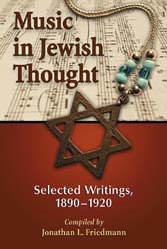
Although the study of Jewish music as a scholarly discipline is still comparatively recent, the publication of two anthologies of older musical thought highlights how the field has matured. The first work is a collection of essays written between the death of Salomon Sulzer (1804–1890), the cantor-composer “rejuvenator” of Ashkenazic synagogue music, and the emergence after World War I of Abraham Z. Idelsohn (1882–1938), the first academically recognized musicologist and ethnomusicologist of Jewish music. What Sulzer and Idelsohn shared in common, according to Friedmann, was a romantic notion of Judaism’s musical past. Just as Sulzer strove “to discover and present ‘purified’ [Ashkenazic] Jewish music” (8), so Idelsohn sought “to uncover unifying elements contained in the music of all Jewish communities, no matter how disparate” (15). The achievements of both engendered a sense of pride in the continuity of Judaism’s religious and cultural past and the Jewish people’s place in the post-Emancipation present.

 Musica Judaica Online Reviews