
You are currently browsing the tag archive for the ‘Germany’ tag.
Hitler’s Twilight of the Gods: Music and the Orchestration of War and Genocide in Europe. Alexandra Birch. Toronto: University of Toronto Press. 2025.
Reviewed by Kathryn Huether

Alexandra Birch’s Hitler’s Twilight of the Gods: Music and the Orchestration of War and Genocide in Europe presents the reader with a dramatic conceit: a Wagnerian scaffolding that traces the role of music and sound in the Nazi project from its rise (“Das Reichgold”) to its collapse (“Trauermusik”). “This is not exclusively a study of Jewish victimhood or of German perpetration,” Birch writes, “but a more nuanced understanding of expanded victim categories, shades of perpetration, the complicated role of bystanders, the archive itself, masculinities, and the Holocaust, and the soundscape of genocide” (9).
Read the rest of this entry »The Moralization of Jewish Heritage in Germany: Sustaining Jewish Life in the Twenty-First Century. Sarah M. Ross. Lanham, MD: Lexington Books. 2024.
Reviewed by Kira Álvarez

Many Germans today regard the preservation of Jewish heritage as a moral responsibility. In The Moralization of Jewish Heritage in Germany: Sustaining Jewish Life in the Twenty-First Century, German ethnomusicologist Sarah M. Ross examines how this responsibility has been addressed. She does this by exploring German Reform and Minhag Ashkenaz synagogue music, examining the roles of both Jewish and non-Jewish stakeholders in contemporary Germany. She highlights the creation of a “community of shared values” based on moral responsibility and feelings of belonging. However, Ross demonstrates that these shared values often reveal more about non-Jewish German society than Jewish society. She argues that Germany’s devotion to moralizing Jewish heritage often leads to an overly static understanding of Judaism and Jewish life, influenced by its Christian surroundings and largely confined to the past. Ross brings new insights to the topic of Jewish heritage in Germany, often regarded as a subject already comprehensively researched. She offers a perspective that is both original and urgent for our current times.
Read the rest of this entry »Time’s Echo: The Second World War, the Holocaust, and the Music of Remembrance. Jeremy Eichler. New York, NY: Alfred A. Knopf. 2023.
Reviewed by Karen Painter

Jeremy Eichler makes a passionate case that as we approach a world without living memory of the Holocaust, there is an “ethical imperative” to attend to “musical memorials” which summon “our commitment to witness” (pp. 174–175). Written when Eichler was classical music critic for the Boston Globe, Time’s Echo bears the fruits of his profession everywhere in eloquent and astute description of music that matters deeply to him. A historian who wrote his dissertation on Schoenberg’s A Survivor from Warsaw, Eichler undertakes the ambitious task of showing how music became so important to German Jews, which finds him starting his story in the Enlightenment, tracing the ideal of Bildung (cultivation) across Central European history. The book’s subtitle notwithstanding, we arrive at World War II only in chapter four out of ten.
Read the rest of this entry »Music of Exile: The Untold Story of the Composers Who Fled Hitler. Michael Haas. New Haven, CT: Yale University Press. 2023.
Reviewed by Dr. Alexandra Birch

Michael Haas’s new book is an expansion of his earlier work on Forbidden Music: The Composers Banned by the Nazis (Yale University Press: 2013) critically reconsidering different modalities of “exile” and the impact of exile on musical composition. Rather than a simple look at only those composers who fled to the United States, Haas engages with larger issues in the historiography of the Holocaust, like the material and financial ability to flee, the change in the perceived danger of Hitler across the 1930s, and how far was far enough to escape the war. Haas also complicates our understanding of those composers who remained in Europe, addressing the spectrum of complicity that they employed in order to continue working in occupied Europe. One of the strengths of the book is Haas’s experience both in performance and the humanities, where he elegantly puts the aesthetics of music in dialogue with Nazi racial and political strictures, emphasizing that denunciation and danger could be on both fronts with “Jewish” music and or a Jewish racial identity. The writing about music never feels cumbersome and is accessible to historians and musicians alike.
Read the rest of this entry »Between Tradition and Modernity: The High Holy Days Melodies of Minhag Ashkenaz According to Ḥazzan Maier Levi of Esslingen. Geoffrey Goldberg. Jerusalem: Jewish Music Research Centre – Hebrew University of Jerusalem. 2019.
Reviewed by Marsha Bryan Edelman

Ethnomusicologist Abraham Zvi Idelsohn (1882-1938) put the study of Jewish music on the scholarly map with the publication of his 10-volume Thesaurus of Hebrew Oriental Melodies (Leipzig: Breitkopf & Härtel et al., 1914–32). Long considered an authoritative resource, Idelsohn’s work has come under some scrutiny by more recent research and by the discovery of additional materials that complement, and occasionally contradict, Idelsohn’s conclusions. The Yuval Music Series, launched by the Jewish Music Research Centre at the Hebrew University of Jerusalem in 1989, has endeavored to provide a sequel to Idelsohn’s research. Geoffrey Goldberg’s Between Tradition and Modernity: The High Holy Day Melodies of Minhag Ashkenaz according to Hazzan Maier Levi of Esslingen is Volume 12 in the Yuval Series, and a most worthy contribution.
Maier Levi (1813 – 1874) is not a well-known name in the history of cantorial music, nor was Esslingen a major center of Jewish life. What makes the present work so valuable is that Levi served as a teacher of hazzanut and prepared his compendium as a study tool for his students at the Esslingen Teachers Seminary from which Levi had also graduated, although at the time, training in hazzanut was very limited; Levi enhanced his own cantorial knowledge through private study with other local hazzanim. In addition to providing details about Levi’s life and career, Goldberg also recounts the history of the types of training available to nineteenth-century hazzanim in Germany (only some of which Levi himself experienced). The key takeaway from this historical background is that Levi lived and taught at a pivotal moment brought about through the Emancipation of German Jewry (1848) and the aesthetic revisionism of the emerging Reform movement (1819). His compendium, completed over the course of many years (1845-late 1860s) thus reflects the changing musical styles Levi and his students would have experienced, and his notations reflect the evolution from “old-world,” often highly embellished tunes, to the more “modern” and unadorned chants in vogue during his later years.
Read the rest of this entry »Sounding Jewish in Berlin: Klezmer Music and the Contemporary City. Phil Alexander. Oxford: Oxford University Press. 2021.
Reviewed by Zeke Levine
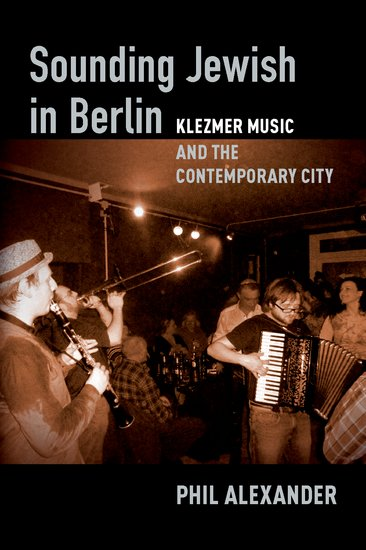
For the past two centuries, Berlin has maintained its role as a central crossroads of global politics, culture, and geography. The German capital is the focus of Phil Alexander’s Sounding Jewish in Berlin. Alexander probes the lively, yet complex contemporary Berlin klezmer scene, delving deeply into the ideological and aesthetic issues that shape it. While the klezmer revival has its roots in the United States, Alexander effectively and engagingly transports the reader to Berlin, an important locus for klezmer performance since the 1980s. Berlin, notes Alexander, is a complex setting for klezmer, given the city’s conflicted relationship with Jewish, particularly Eastern European Jewish, communities and folkways. Throughout the text, Alexander highlights thirty musicians and other creatives on the Berlin scene, framing the book around their experiences as well as his own extensive ethnographic experience as both a performer in, and keen observer of, the scene.
Read the rest of this entry »A Jewish Orchestra in Nazi Germany: Musical Politics and the Berlin Jewish Culture League. Lily E. Hirsch. Ann Arbor: University of Michigan Press, 2010. ISBN 978-0-4721-1710-9
Reviewed for Musica Judaica Online Reviews by Barbara Milewski
 During the last two decades a formidable number of excellent studies have appeared in English and German that have given us an ever fuller picture of the compromised, politicized reality of Germany’s musical culture during the National Socialist period. Lily Hirsch’s book, A Jewish Orchestra in Nazi Germany: Musical Politics and the Berlin Jewish Culture League, is a valuable contribution to this body of knowledge.
Hirsch draws on previous scholarship published in Germany—notably Henryk Broder and Eike Geisel’s Premiere und Pogrom: der Jüdische Kulturbund 1933-1941, and Geschlossene Vorstellung: Der Jüdische Kulturbund in Deutschland 1933-1941 published in conjunction with a 1992 exhibit at Berlin’s Akademie der Künste, which houses the Kulturbund archives—and significantly expands on this material through interviews with League members and subsequent archival investigations. In so doing, she makes available to Anglophone readers for the first time a comprehensive and nuanced telling of the origins and activities of the Jüdischer Kulturbund, or Jewish Culture League, the self-imagined, Nazi sanctioned, Jewish cultural organization that staged musical and theatrical performances for Jewish audiences in Nazi Germany between 1933 and its disbanding in 1941. As Hirsch’s study makes clear, the League’s history remains one of the more poignant examples of the complex, ever-narrowing field of choices Germany’s Jews were forced to navigate after the Nazis assumed power and enacted anti-Jewish exclusionary legislation (intended to protect the purity of Aryan culture) that restricted all aspects of their public and private lives.
Music in Terezín 1941-1945. Joža Karas. 2nd ed. Hillsdale, NY: Pendragon Press, 2009. ISBN 978-1-5764-7030-5
The Wonder and the Grace of Alice Sommer Herz: Everything is a Present. Dir. Christopher Nupen. DVD and Liner Notes. Allegro Films, 2009.
Reviewed by Shirli Gilbert
Shortly before his death in December 2008 Joža Karas completed the second edition of his book Music in Terezín 1941-1945, the culmination of a life’s work. When the book was originally published in 1985 it was path-breaking, documenting a largely unknown chapter in the history of the Holocaust: the lively and wide-ranging musical life in the “model ghetto” Terezín (in Czech, Theresienstadt in German). When Karas began his work as a “modest summer project” in 1970 (ix), very little music from the ghetto had been uncovered, and even less had been written about it. Karas, a Czech researcher and musician based in Connecticut, devoted the rest of his life to passionately researching the subject, conducting interviews across Europe, Israel, and the United States, undertaking archival research, and transcribing scores. In addition to publishing his book, he lectured widely on the subject, produced performing editions, and tirelessly promoted Terezín compositions in performances with his own string quartet, established expressly for that purpose. Karas himself conducted the American premiere of Brundibár in 1975 and the world premiere of the English version (in his own translation) in 1977. In short, the subject of music in Terezín has become well known among Western audiences thanks in large part to Karas’s pioneering efforts. Read the rest of this entry »
Judaism Musical and Unmusical. Michael P. Steinberg. Chicago: University of Chicago Press, 2007. 270 pp. ISBN 978-0-2267-7195-3
Reviewed by Tina Frühauf
In Judaism Musical and Unmusical, Michael P. Steinberg takes the reader on a journey through predominantly but not exclusively Central European Jewish history and culture in the nineteenth and twentieth centuries, at times privileging music as a focal point of cultural discourse. The eight essays in this volume, most of which have been published before, are loosely connected musings about the different facets of modernity and Judentum, and involve the concepts of memory, secularity, and aesthetics, among others. In each chapter Steinberg weaves different threads together, from art to psychoanalysis, from architecture to music. Steinberg’s book, which in a larger sense is a discourse about identity and Judaism, begins with an essay on Edward Said and his propositions of Jewish identity, and follows with individual case studies of known intellectuals and their work. Steinberg traces the subject of Judaism in Sigmund Freud’s late classic Moses and Monotheism and in the writings of Henry James, Eduard Fuchs, and Walter Benjamin; and he explores the intellectualism of Italian Jewish historian Arnaldo Momigliano. Further chapters center on the artist Charlotte Salomon and her Life? or Theater? and Leonard Bernstein in Vienna. The journey ends in Berlin with a critique of its Jewish Museum and an assessment of some recent scholarship on German Jewish subjects, which cannot compensate for the absence of a full bibliography at the end of the book.

 Musica Judaica Online Reviews