Kabbalachiaby Basya Schechter and Shaul Magid(2024)
Album review by Gabby Cameron
As the sun sets on a Friday evening over Fire Island, congregants gather at the Fire Island Synagogue to welcome Shabbat, donning their kippahs and tallit with shorts and sandals. What type of music might one hear in such a setting? Together, Cantor Basya Schechter and Rabbi Shaul Magid developed a localized musical tradition of setting Kabbalat Shabbat texts to Appalachian old-time music. Over the course of a decade, Kabbalachia was born.
For Women and Girls Only: Reshaping Jewish Orthodoxy Through the Arts in the Digital Age. Jessica Roda. New York, NY: New York University Press. 2024.
Reviewed by Miranda Crowdus
In this book, Jessica Roda explores a recently emergent phenomenon enabled to a large degree by the possibilities of the digital age. Roda explores Orthodox Jewish women’s musical and theatrical performances for women and by women, drawing on years of recent fieldwork including participant observation and in-depth interviews.Roda’s book is a holistic tour-de-force representing the networks, relationships, spaces and venues – human, digital, geospatial, and other – through which these performances are created, rehearsed, and broadcast. This investigation includes a sensitive and honest reflection on the author’s own positionality and enmeshment, not only within the communities and in relation to the individuals under focus but also more broadly to the state of belonging to the Jewish community and being a woman in North America in the twenty-first century. In these dense and detailed portrayals, the results of a wealth of engaged, detailed, and multifaceted fieldwork, the emergence of the kol isha (the voice of a woman) “industry” to its current proliferation, and rich descriptions of the women’s and others’ negotiations with halacha (Jewish law) are explored in detail. It should be noted that such negotiations are normative in Judaism across denominations. But, as the book clearly explains, what differentiates the Hasidic and Haredi communities is their adherence to the authority of the rebbe (or rabbi) in these negotiations.
Music of Exile: The Untold Story of the Composers Who Fled Hitler. Michael Haas. New Haven, CT: Yale University Press. 2023.
Reviewed by Dr. Alexandra Birch
Michael Haas’s new book is an expansion of his earlier work on Forbidden Music: The Composers Banned by the Nazis (Yale University Press: 2013) critically reconsidering different modalities of “exile” and the impact of exile on musical composition. Rather than a simple look at only those composers who fled to the United States, Haas engages with larger issues in the historiography of the Holocaust, like the material and financial ability to flee, the change in the perceived danger of Hitler across the 1930s, and how far was far enough to escape the war. Haas also complicates our understanding of those composers who remained in Europe, addressing the spectrum of complicity that they employed in order to continue working in occupied Europe. One of the strengths of the book is Haas’s experience both in performance and the humanities, where he elegantly puts the aesthetics of music in dialogue with Nazi racial and political strictures, emphasizing that denunciation and danger could be on both fronts with “Jewish” music and or a Jewish racial identity. The writing about music never feels cumbersome and is accessible to historians and musicians alike.
This Is Your Song Too: Phish and Contemporary Jewish Identity. Edited by Oren Kroll-Zeldin and Ariella Werden-Greenfield. University Park, PA: Penn State University Press. 2023.
Reviewed by Dr. Robert J Wuagneux
What is the connection between Phish and contemporary Jewish identity? Why does Phish have a disproportionately large Jewish fanbase? Editors Oren Kroll-Zeldin and Ariella Werden-Greenfield argue that the answer to these questions lies in a complex mosaic of religious and cultural ties that link Phish’s music and their fans’ complementary scene practices with Jewishness. Using a broad and inclusive understanding of Jewishness, this book counts all who identify as “Jewish” as Jews and all who identify as Phish fans as such.
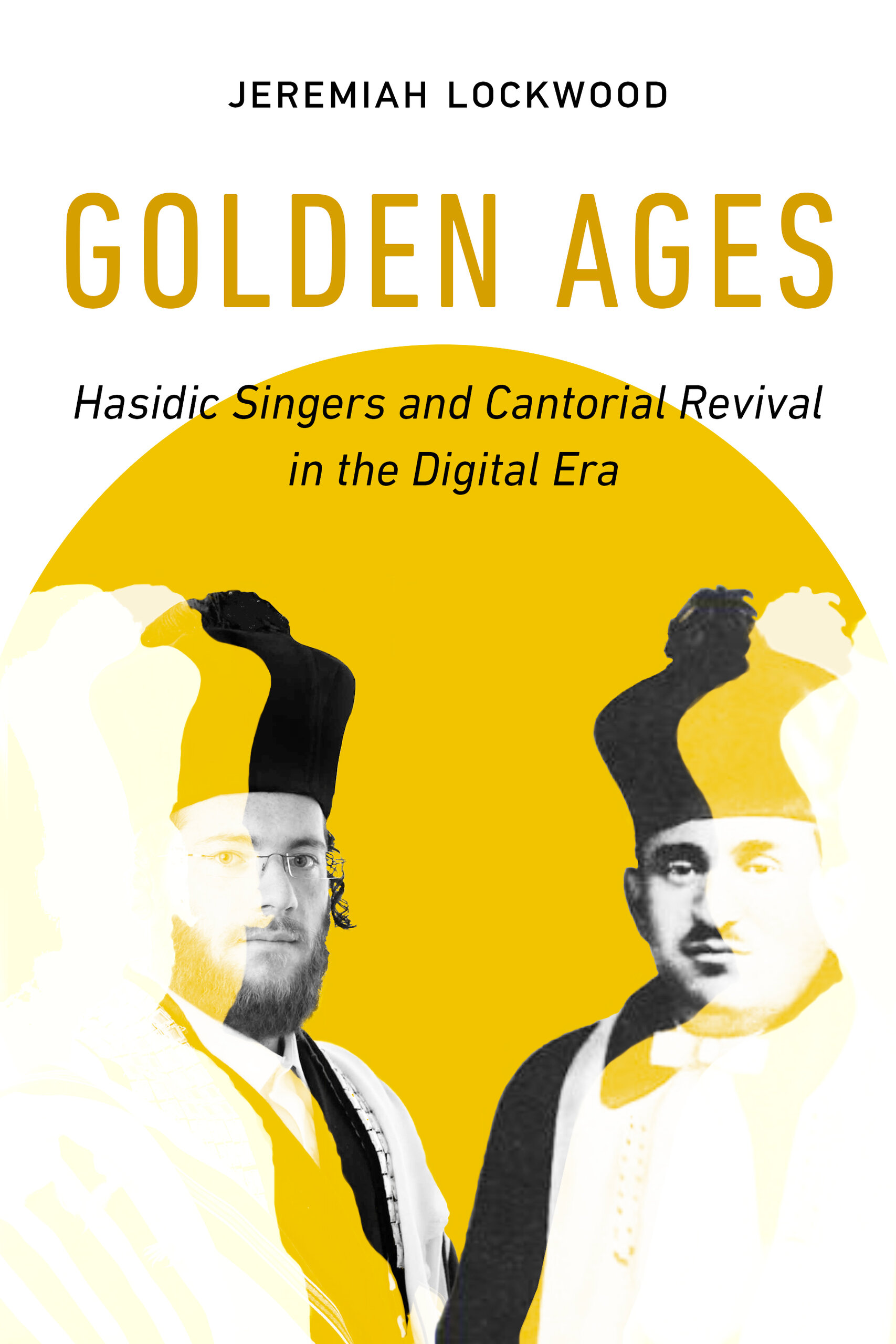
Golden Ages: Hasidic Singers and Cantorial Revival in the Digital Era. Jeremiah Lockwood. Berkeley and Los Angeles, CA: University of California Press. 2024.
Reviewed by Matthew Austerklein
Jeremiah Lockwood’s new book, Golden Ages: Hasidic Singers & Cantorial Revival in the Digital Era (University of California Press, 2024) is the culminating work of a determined and thoughtful advocate of cantorial music. The grandson of Cantor Jacob Konigsberg, Lockwood is a scholar-activist with a long history of academic achievement and musical creativity [1]. This new work continues that trajectory, combining a thorough study of cantors with hints of an emerging musical ideology. At the center of his groundbreaking book are the stories of a small group of Hasidic singers in Brooklyn who are reviving Golden Age cantorial music through performance and recording, all while negotiating their countercultural love of this expressive art form within the skeptical world of Hasidic Judaism and the largely pop-music ethos of the Orthodox synagogues in which they serve.
La Memoria Cantata: A Survivor from Warsaw di Arnold Schönberg nell’Europa del dopoguerra. Joy H. Calico. Edizione italiana a cura di Paolo Dal Molin, traduzione di Silvia Albesano. Milan: Il Saggiatore. 2023.
Reviewed by Jesse Rosenberg
On the list of musical works inspired by the Shoah, Arnold Schoenberg’s A Survivor from Warsaw has long held a special status. The realistic description of a roundup of Jews in the Warsaw ghetto, the concluding choral Shema that constitutes one of the strongest testimonies of Schoenberg’s re-commitment to Judaism in the last two decades of his life, and the combination of advanced twelve-tone technique with Sprechstimme, one of the composer’s earliest innovations, unite to make a powerful impression on listeners to this day. In her 2014 monograph Arnold Schoenberg’s “A Survivor from Warsaw” in Postwar Europe, dedicated to the reception of this work, Joy H. Calico documents in detail the effect of this work on European critics and audiences, and subjects it to a thorough analysis.
“The Soul Seeks Its Melodies”: Music in Jewish Thought. Dov Schwartz. Translated by Batya Stein. Brookline, MA: Academic Studies Press. 2022.
Reviewed by Aubrey L. Glazer
When we listen deeply to music, we realize the truth that “[e]very musical phenomenon points to something beyond itself by reminding us of something, contrasting itself with something or arousing our expectations.” [1] Such a reflection from German Jewish philosopher and pianist Theodor Adorno’s prolific musical thinking appears in a 1963 essay collected in the book Quasi Una Fantasia. Adorno was a prolific Jewish thinker who spent a lifetime reflecting on how music is itself a thought process by which content is defined “not because its particular elements express something symbolically” but through a paradoxical process of “distancing itself from language that its resemblance to language finds it fulfillment.” [2] To enter into the realm of analyzing music in Jewish thought, one would therefore expect these kinds of approaches to musical thinking to be engaged as a starting point. It is striking, then, to suggest that music can be a power to “communicate without words,” as Dov Schwartz concludes in his recent book “The Soul Seeks Its Melodies”: Music in Jewish Thought, writing that this is “one of the deepest meanings of music as a language” (299). The contrast between these distinct approaches to musical thinking and its language in Adorno and Schwartz would have been a natural starting point to fill an entire book. However, Adorno’s absence from this monographreveals much about the foundations of Dov Schwartz’s philosophical approach.
The Oxford Handbook of Jewish Music Studies. Edited by Tina Frühauf. Oxford and New York: Oxford University Press. 2023.
Reviewed by Paul G. Feller-Simmons
The publication of The Oxford Handbook of Jewish Music Studies, edited by Tina Frühauf, marks a much-anticipated milestone. Released in November of 2023, the weighty tome attests to the rapidly changing landscape of the field, offering a comprehensive exploration of manifold subjects. With twenty-nine chapters plus an introduction penned by scholars at various stages of their careers, the Handbook truly mirrors the best facets of the field’s current state. While it would be a daunting task to do justice to every chapter within the confines of this review, particularly for an avowed early modernist such as myself, it suffices to say that the volume exudes scholarly rigor and innovation.
City of Song: Music and the Making of Modern Jerusalem. MichaelA. Figueroa. Oxford: Oxford University Press. 2022.
ReviewedbyTanyaSermer
Michael A. Figueroa’s captivating City of Song: Music and the Making of Modern Jerusalem is a book about Jerusalems—high/low, celestial/terrestrial, metaphorical/material—and how musical representations of the city have produced a multiplicity of political imaginaries about those Jerusalems in modernity. Combining an impressive array of interdisciplinary theory, historical and archival study, ethnographic fieldwork, and close listening to songs in Hebrew about the city, Figueroa creates a sophisticated framework for understanding how music and poetry (from the Psalms through Israeli popular song of the 1970s) have been used to create subjective and changing “spatial knowledge” about Jerusalem among Zionist Jews and Israelis over the course of the twentieth century. Presenting a remarkably nuanced exploration of the contested meanings inherent in cultural output regarding the city, Figueroa is deliberate in his relational approach to the people and spaces in his study; discussions of Jerusalem throughout the book consider the perspectives and concerns of Palestinian Arabs, Armenians, or ethnic and religious divisions within the Jewish and Israeli populations. Figueroa’s commitment to a relational approach—a growing body of such scholarship in musical studies of Israel and Palestine that aims to break down the mutual exclusion of those two national narratives as well as the conventional dichotomies within them—offers the reader a rich picture of the social and political forces at play and the greater implications of the territorial imaginaries that underpin the songs Figueroa examines.
Encyclopaedia of British Jewish Cantors, Chazanim, Ministers and Synagogue Musicians: Their History and Culture. Michael Jolles. London: Jolles Publications. 2021.
Reviewed by Judith S. Pinnolis
Without question, this monumental work of nearly 900 pages (and growing) is a vast achievement and watershed moment in the history of Jewish music in the United Kingdom. The volume gathers and documents a vast historical record in a single compendium. Historian Michael Jolles has created an unparalleled resource available to anyone with an internet connection. While supported by an editorial board, the work displays the views and perspective of a single individual, which Jolles has dubbed a “framework” for the study of British chazanim (the religious prayer leader), synagogue musicians, and institutions. The work also includes lists of rabbis, composers and others contributing to synagogue music. The detailed facts and figures collected represent an amalgamation from myriad archival and research resources into an organized collection. The volume is organized in two main parts. The first describes the roles of the various musicians of the synagogue and the attending historical and cultural backgrounds, which serve as introductory materials, and the second consists of a collection of biographical sketches of various lengths and depths, which date from names known as early as 1656 up to the present.




 Musica Judaica Online Reviews