
Unsettling Difference: Music Drama, the Bible, and the Critique of German Jewish Identity. Adi Nester. Ithaca: Cornell University Press. 2025.
Reviewed by Madison Schindele and Samuel Teeple
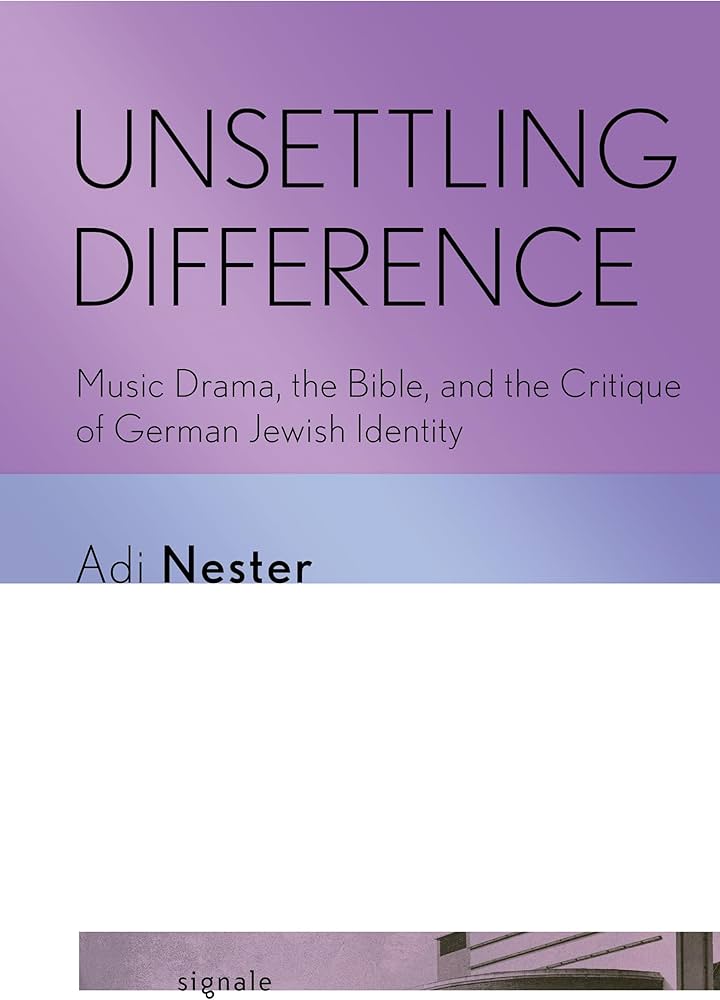
In her 2025 monograph Unsettling Difference: Music Drama, the Bible, and the Critique of German Jewish Identity, Adi Nester offers a textually grounded analysis of the German-Jewish relationship as it emerged in music drama in the first half of the twentieth century. Nester focuses on musical settings of biblically-themed texts: Rudolf Borchardt’s poem Das Buch Joram and its oratorio realization by Paul Ben-Haim; Schoenberg’s Moses und Aaron; Joseph Roth’s novel Hiob and Eric Zeisl’s opera of the same name. Throughout her discussions of these works, Nester pushes back against “the stagnant major-minor relation that has long served scholars in their definition of the German Jewish condition,” arguing that, even in the face of hardening racial logics, Jewish difference (what Nester calls the difference between German and Jew) actively unsettles any effort to categorize or contain it. [1] While this critical reorientation is not necessarily novel—since the 1990s, German Jewish Studies has increasingly recognized the fluid, entangled relationship between the categories of German and Jew—Unsettling Difference presents a convincing interpretation of this dynamic as expressed in musical texts, locating moments of role reversal, confusion, and ambiguation as aesthetic disruptions. [2]
In light of the central role of music in Nester’s approach, readers may view this book as the latest entry in a growing body of musicological literature that investigates Jewish-Christian relations as mediated by music, from Ruth HaCohen’s The Music Libel Against the Jews [3] to Caroline Kita’s Jewish Difference and the Arts in Vienna: Composing Compassion in Music and Biblical Theater. [4] While Nester does reference this scholarship to varying degrees, Unsettling Difference is perhaps best framed as an extension of cultural and historical studies of the Hebrew Bible’s German reception, bridging the Enlightenment-era findings of Jonathan Hess and Ofri Ilany into her own, later period. [5] Broadly speaking, however, the most cogent insights of this book emerge less from Nester’s engagement with recent academic work than her reflections on the writings of nineteenth- and twentieth-century figures, from Hegel and Wagner to Adorno and Arendt. Each chapter consists of a close reading of the composition or text at hand, interpreted through the writings of these external, temporally removed interlocutors. Nester’s chapters are further populated by a familiar combination of historical narrative, theory, and biography, contextualized alongside other writings by the author and/or composer at hand.
Although Nester acknowledges the broader applicability of unsettling difference as a methodological approach in other contexts, she explicitly delimits her own project as originating in the temporal and ideological wake of Richard Wagner, a dividing line that invokes the intertwined legacy of the composer’s aesthetic agenda and racialized völkisch politics. In the aftermath of Wagner, Nester asserts that “challenging the notion of a closed, organic artwork is tantamount to resisting the corresponding notion of a complete, organic, and homogeneous German collective.” [6] Against the totalizing authority of the Wagnerian Gesamtkunstwerk, Nester locates unsettled difference in artworks that dwell in fragment, heterogeneity, and openness, themes that emerge idiosyncratically in each of her analyses.
Her first two chapters examine Rudolf Borchardt’s 1907 narrative poem Das Buch Joram and its musical setting, Paul Ben-Haim’s 1932 oratorio Joram. Nester positions Borchardt’s text, a modernist reworking of the Book of Job in the German of Martin Luther, as an attempt to claim Luther’s Bible as “a quintessentially German literary monument” purged of its “oriental” (read: Hebrew) nature. [7] In her close reading of the poem, Nester calls upon Naomi Seidman’s work exploring translation as a site for Jewish-Christian encounter, theorizing that translation assumes connection, but also difference, equivalence, and transmutation. [8] Nester clarifies the aesthetic and theological stakes of Borchardt’s “German” position against the “Jewish” translational ethics of Martin Buber and Franz Rosenzweig, identifying moments of contradiction and exchange between the two that undermine their respective identities. In the following chapter’s examination of Ben-Haim’s Joram, Nester historicizes the genre of the German oratorio through Benjamin’s reflections on the Baroque Trauerspiel and the Passions of Johann Sebastian Bach. Drawing on HaCohen’s formulation of “oratorical moments” that emerge through the crossing of dramatic planes between performer and audience, Nester explores how the oratorio can elicit moments of sympathetic understanding between German Christians and Jews, unsettling Jewish difference through its fragmented, open-ended nature.
Nester dedicates a single chapter to Schoenberg’s unfinished opera Moses und Aron (1932–1951) and its law-bound, twofold problem of representation, which she conceptualizes as the Darstellung of the law and the Vertretung of the people. By situating the opera in conversation with Schoenberg’s political writings on the problems of democracy, Nester fleshes out her critique of collective identity as inherently unstable. Nester hears this conflict expressed in the opera through the interplay between the single, law-bound twelve-tone row and the chorus as a mutable, heterogenous body in motion. Reflecting on the unfinished nature of the work, Nester argues that Moses und Aron resists the totality of the closed Wagnerian paradigm through the aesthetic expression of fragmentation and the absence of tonal infrastructure.
Across the final two case studies—Joseph Roth’s novel Hiob (1930) and Eric Zeisl’s unfinished operatic realization of the same name (1939–1959)—Nester synthesizes a critique of integrative assimilation and the modern nation-state, transposed to an American setting. Like Borchardt’s Das Buch Joram, the title of Roth’s novel gestures toward the eponymous character’s connection to Job—this reworking of the biblical story narrates the immigration of Mendel Singer, the prototypical Ostjude, from the Russian Empire to New York City and his open refusal to assimilate into the American mainstream. By reading Roth’s novel and biography alongside Hannah Arendt’s writings on assimilation, Nester theorizes the productive capacity of excess, a superfluous quantity that stands apart from the nation-state, as “the only true form of emancipation.” [9] In her analysis of Zeisl’s operatic setting of Roth’s novel, Nester hears this excess in what she describes as Zeisl’s quotational and repetitional practice, aligning superfluousness with a (non)relation to meaning. Nester relates Zeisl’s compositional excess to that of Mahler, reading Zeisl and Mahler’s quotation and repetition of the German cultural vernacular (the traditional, Western classical idiom) as undermining the originary status of the quoted or repeated original, offering an “alternative view of Jewish difference that exceeds the contained economy of a German Jewish identity.” [10]
Music scholars might wish for a more in-depth analysis or extended interaction with contemporary music scholarship in Nester’s reading of Hiob, especially as she later claims that Zeisl’s quotational practices usurp Wagnerian and Schenkerian modes of hegemony. Likewise, in her analysis of Zeisl’s compositional style, Nester offers a few brief pages to address the presence of “Jewish music” in Hiob—the only discussion of it in the book—beyond her analysis of Zeisel’s inclusion of modal harmonies and his adherence to traditional aesthetic forms. Throughout each case study, much of Nester’s musical discussion emerges in conversation with one of her twentieth-century interlocutors, most often Adorno. This generates layered, in-depth interpretations, but can leave the reader wondering to what extent her findings are echoed by others in musical disciplines. Furthermore, Nestor’s method leaves little room for discussions of more recent stagings or reworkings of her chosen case studies, with the most notable exclusion being Jan Duszyński and Miron Hakenbeck’s 2014 “completion” of the uncompleted Hiob. [11]
While musicologists and music theorists might have written about these compositions with different questions in mind, Unsettling Difference excels as a work of textual criticism; through her analysis, Nester enacts the anti-Wagnerian open orientation she locates in each work by placing them in dialogue with German Jewish voices at a remove. Perhaps the book’s most admirable contribution lies in its methodological approach: by assembling a framework of distinct aesthetic features to index the otherwise amorphous object of “Jewish difference,” Nester demonstrates how specific qualities like excess and repetition can be interpreted as explicitly political formulations. Readers working in other disciplines, genres, or periods may well find in Nester’s writing a generative springboard for their own inquiries into artistic expressions of German Jewish modernity. In an academic context that too often encourages scholars to prioritize depth over breadth, Unsettling Difference is unafraid to engage with the “grand narratives” that underlie the foundational assumptions of our fields, from the Wagnerian legacy of the closed work to the biblical supersessionism at the heart of the Enlightenment. In her introduction, Nester characterizes her book as a call to “move away from the view of German Jewish marginality and imagine an alternative relation between the German and Jewish positions.” [12] In the coming years, we look forward to seeing how scholars of German Jewish music take up this challenge.
Madison Schindele, Freie Universität Berlin & The Graduate Center, CUNY. Madison Schindele is a doctoral candidate in Musicology at the Graduate Center, CUNY and a Fulbright research awardee at the Freie Universität Berlin for the 2025–2026 academic year. Her research interests lie in the intersection of opera, gender, and disability, with a specific focus on the politicization of procreation in interwar German-language opera and gynecological trauma in performances of opera today. Her dissertation project centers on representations of in/fertility in Strauss and Hofmannsthal’s opera Die Frau ohne Schatten.
Samuel Teeple, The Graduate Center, CUNY. Samuel Teeple is a doctoral candidate in musicology at the Graduate Center, CUNY, where his dissertation “Jewish Berlin and the Musical Formation of Germanness, 1780–1830” examines the relationship between German Jews and nationalizing discourses of German music in Berlin’s synagogues, salons, and musical societies, exploring how music enacts categorical boundaries of race, gender, and the human. His most recent publication, “The Aesthetics of the Musical Salon and Jewish Reform at the Home of Amalie Beer,” appears in the edited collection Four Centuries of Musical Salons: A Cross-Cultural History (Cambridge University Press, 2026).
[1] Adi Nester, Unsettling Difference: Music Drama, the Bible, and the Critique of German Jewish Identity (Cornell University Press, 2025), 253–54.
[2] One iteration of this approach can be found in Steven Aschheim’s “co-constitutive model”; see Steven Aschheim, “German History and German Jewry: Boundaries, Functions and Interdependence,” The Leo Baeck Institute Year Book 43, no. 1 (1998): 315–22. For a more recent discussion of this shift, see Michael A. Meyer, “The Dynamic Relationship of ‘German’ and ‘Jewish,’” in German–Jewish Studies: Next Generations, ed. Kerry Wallach and Aya Elyada (Berghahn Books, 2023), 269–78.
[3] Ruth HaCohen, The Music Libel Against the Jews (Yale University Press, 2012).
[4] Caroline A. Kita, Jewish Difference and the Arts in Vienna: Composing Compassion in Music and Biblical Theater (Indiana University Press, 2019).
[5] Jonathan M. Hess, Germans, Jews, and the Claims of Modernity (Yale University Press, 2002). Ofri Ilany, In Search of the Hebrew People: Bible and Nation in the German Enlightenment (Indiana University Press, 2018).
[6] Nester, Unsettling Difference, 30.
[7] Nester, Unsettling Difference, 63.
[8] Naomi Seidman, Faithful Renderings: Jewish Christian Difference and the Politics of Translation (University of Chicago Press, 2006).
[9] Nester, Unsettling Difference, 171.
[10] Nester, Unsettling Difference, 34.
[11] Malcolm S. Cole, “A Miracle in Munich: The Bavarian State Opera Premieres Zeisls Hiob,” Music Restored: The Ziering-Conlon Center for Exiled and Suppressed Composers, May 17, 2015, https://musicrestored.org/a_miracle_in_munich_the_bavarian_state_opera_premieres_zeisls_hiob/.
[12] Nester, Unsettling Difference, 29.


Leave a comment
Comments feed for this article