
You are currently browsing the tag archive for the ‘Popular Music’ tag.
Mediterranean Israeli Music and the Politics of the Aesthetic. Amy Horowitz. Detroit: Wayne State University Press, 2010. xvii+251 pp. (+ 19 songs on CD). ISBN 978-0-8143-3465-2
Reviewed by Motti Regev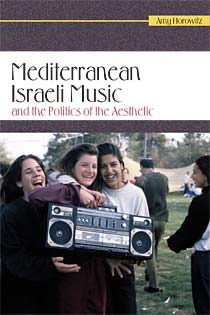
Musiqa mizrahit, aka Israeli Mediterranean Music, is a category of popular music mostly known for its strong Middle Eastern and Greek tinges. It has been at the center of Israeli public discourse on popular music since the late 1970s. By 2010, the leading theme of this discourse is the “triumph” of the genre in the field of Israeli popular music. With prominent performers such as Sarit Hadad, Eyal Golan, Kobi Peretz, Moshe Peretz, Shlomi Shabat, Lior Narkis and others filling up the largest music venues in Israel, leading the sale charts and ruling the radio airwaves, Israeli Mediterranean Music is by 2010 the “mainstream” of Israeli popular music. Throughout its history, speakers for Israeli Mediterranean Music have insisted, against their marginalization, that this genre is the “true” Israeli authentic popular music, the one that should be at center stage of Israeli culture. Given the genre’s success in the 1990s and the 2000s, Edwin Seroussi and myself concluded some years ago that “the nationalist impetus that underlined musiqa mizrahit for decades has achieved its own self-declared goal of both bringing musiqa mizrahit into the mainstream of Israeli popular music and of affecting the sounds of all popular music in Israel.”[1] Read the rest of this entry »
Jewish Music and Modernity. Philip V. Bohlman. New York: Oxford University Press/AMS Studies in Music, 2008. xxxiii + 280 pp. ISBN 978-0-1951-7832-6
Reviewed by Lisa Parkes
Discourse about “Jewish music” has traditionally raised complex questions about the identity of “Jewishness” in music. The ontology of “Jewish music” in modern Jewish history is as elusive as the nature of music itself. The reason for this, as Philip Bohlman argues in Jewish Music and Modernity, is that Jewish music in modernity exists not within a definable space or time, but rather at moments of disjuncture – in between regions, amid moments of transition and transformation, and at the border of ethnic, religious, and social boundaries. Jewish music, as an aesthetically autonomous object in Jewish society, was conceived of for the first time at the modernist moment, when Jews entered the public sphere of modern European society, broadening the purely ritualized devotional function that music formerly served. But the structural transformation that modernity brought about in musical culture had the paradoxical effect of confounding the very notion of “Jewish” music. Exposed to modern musical practices and genres in the non-Jewish public sphere during a period of political and aesthetic transformation, Jewish music became “Jewish” precisely in its confrontation with non-Jewish genres, forms, languages, and performers. Bohlman demonstrates that Jewish music, in responding to the political and aesthetic challenges of modernity, is inherently hybrid, unstable, and dynamic. It represents a dynamic site where national, ethnic, and gender identities are constructed and contested. Thus, borders between Jewish and non-Jewish became permeable, so that “musical repertories that for some were entirely Jewish—say, cabaret at the turn of the twentieth century—were not the least bit Jewish for others” (xvii). In other words, music participated in the transformation of modern Jewish identity itself.
Read the rest of this entry »
Jews, Race and Popular Music. Jon Stratton. Burlington, VT: Ashgate, 2009. 238 pp. ISBN 978-0-7546-6804-6
Rev iewed by Ari Y. Kelman
In Jews, Race and Popular Music, Jon Stratton attempts to stage an intervention at the fulcrum of the peculiar relationship between Jews and popular music. The historical coincidence of Jewish people and African American musical styles—from Al Jolson to Amy Winehouse—has become something of a cottage industry both in and beyond the university (Stratton includes a comprehensive listing of titles in his introduction). In this work, Stratton is trying to reframe this well-documented yet still vexing area of research through the lenses of race and performance. The trouble is that he offers an argument that tries so hard to deconstruct Jewishness that he ends up reifying it.

 Musica Judaica Online Reviews