
You are currently browsing the tag archive for the ‘Popular Music’ tag.
Kabbalachia by Basya Schechter and Shaul Magid (2024)
Album review by Gabby Cameron

As the sun sets on a Friday evening over Fire Island, congregants gather at the Fire Island Synagogue to welcome Shabbat, donning their kippahs and tallit with shorts and sandals. What type of music might one hear in such a setting? Together, Cantor Basya Schechter and Rabbi Shaul Magid developed a localized musical tradition of setting Kabbalat Shabbat texts to Appalachian old-time music. Over the course of a decade, Kabbalachia was born.
Read the rest of this entry »For Women and Girls Only: Reshaping Jewish Orthodoxy Through the Arts in the Digital Age. Jessica Roda. New York, NY: New York University Press. 2024.
Reviewed by Miranda Crowdus

In this book, Jessica Roda explores a recently emergent phenomenon enabled to a large degree by the possibilities of the digital age. Roda explores Orthodox Jewish women’s musical and theatrical performances for women and by women, drawing on years of recent fieldwork including participant observation and in-depth interviews. Roda’s book is a holistic tour-de-force representing the networks, relationships, spaces and venues – human, digital, geospatial, and other – through which these performances are created, rehearsed, and broadcast. This investigation includes a sensitive and honest reflection on the author’s own positionality and enmeshment, not only within the communities and in relation to the individuals under focus but also more broadly to the state of belonging to the Jewish community and being a woman in North America in the twenty-first century. In these dense and detailed portrayals, the results of a wealth of engaged, detailed, and multifaceted fieldwork, the emergence of the kol isha (the voice of a woman) “industry” to its current proliferation, and rich descriptions of the women’s and others’ negotiations with halacha (Jewish law) are explored in detail. It should be noted that such negotiations are normative in Judaism across denominations. But, as the book clearly explains, what differentiates the Hasidic and Haredi communities is their adherence to the authority of the rebbe (or rabbi) in these negotiations.
Read the rest of this entry »This Is Your Song Too: Phish and Contemporary Jewish Identity. Edited by Oren Kroll-Zeldin and Ariella Werden-Greenfield. University Park, PA: Penn State University Press. 2023.
Reviewed by Dr. Robert J Wuagneux

What is the connection between Phish and contemporary Jewish identity? Why does Phish have a disproportionately large Jewish fanbase? Editors Oren Kroll-Zeldin and Ariella Werden-Greenfield argue that the answer to these questions lies in a complex mosaic of religious and cultural ties that link Phish’s music and their fans’ complementary scene practices with Jewishness. Using a broad and inclusive understanding of Jewishness, this book counts all who identify as “Jewish” as Jews and all who identify as Phish fans as such.
Read the rest of this entry »Golden Ages: Hasidic Singers and Cantorial Revival in the Digital Era. Jeremiah Lockwood. Berkeley and Los Angeles, CA: University of California Press. 2024.
Reviewed by Matthew Austerklein
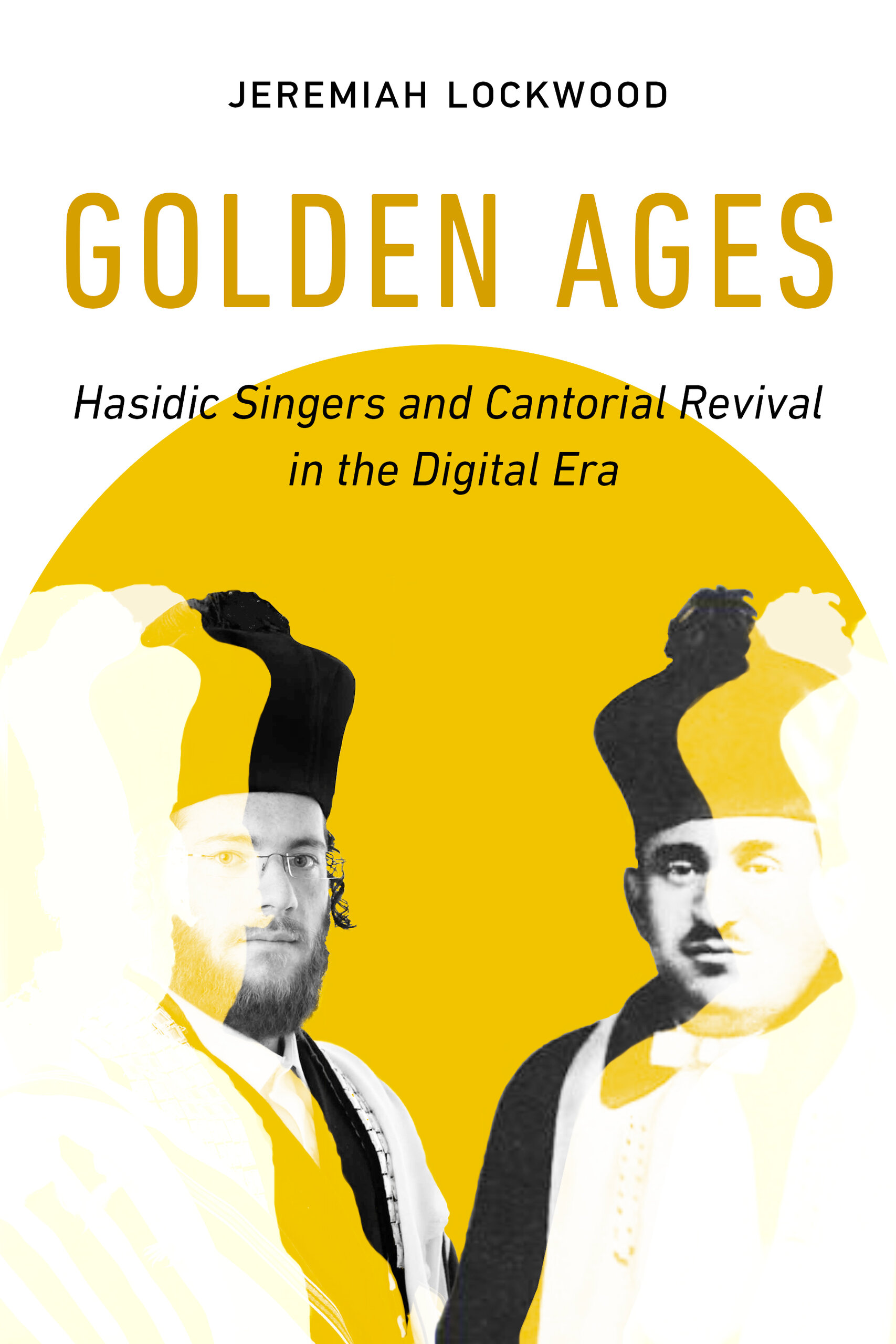
Jeremiah Lockwood’s new book, Golden Ages: Hasidic Singers & Cantorial Revival in the Digital Era (University of California Press, 2024) is the culminating work of a determined and thoughtful advocate of cantorial music. The grandson of Cantor Jacob Konigsberg, Lockwood is a scholar-activist with a long history of academic achievement and musical creativity [1]. This new work continues that trajectory, combining a thorough study of cantors with hints of an emerging musical ideology. At the center of his groundbreaking book are the stories of a small group of Hasidic singers in Brooklyn who are reviving Golden Age cantorial music through performance and recording, all while negotiating their countercultural love of this expressive art form within the skeptical world of Hasidic Judaism and the largely pop-music ethos of the Orthodox synagogues in which they serve.
Read the rest of this entry »City of Song: Music and the Making of Modern Jerusalem. Michael A. Figueroa. Oxford: Oxford University Press. 2022.
Reviewed by Tanya Sermer

Michael A. Figueroa’s captivating City of Song: Music and the Making of Modern Jerusalem is a book about Jerusalems—high/low, celestial/terrestrial, metaphorical/material—and how musical representations of the city have produced a multiplicity of political imaginaries about those Jerusalems in modernity. Combining an impressive array of interdisciplinary theory, historical and archival study, ethnographic fieldwork, and close listening to songs in Hebrew about the city, Figueroa creates a sophisticated framework for understanding how music and poetry (from the Psalms through Israeli popular song of the 1970s) have been used to create subjective and changing “spatial knowledge” about Jerusalem among Zionist Jews and Israelis over the course of the twentieth century. Presenting a remarkably nuanced exploration of the contested meanings inherent in cultural output regarding the city, Figueroa is deliberate in his relational approach to the people and spaces in his study; discussions of Jerusalem throughout the book consider the perspectives and concerns of Palestinian Arabs, Armenians, or ethnic and religious divisions within the Jewish and Israeli populations. Figueroa’s commitment to a relational approach—a growing body of such scholarship in musical studies of Israel and Palestine that aims to break down the mutual exclusion of those two national narratives as well as the conventional dichotomies within them—offers the reader a rich picture of the social and political forces at play and the greater implications of the territorial imaginaries that underpin the songs Figueroa examines.
Read the rest of this entry »Let Our Music Be Played: Italian Jewish Musicians and Composers under Fascism. Edited by Alessandro Carrieri and Annalisa Capristo. Cham, Switzerland: Palgrave Macmillan. 2021.
Reviewed by Jesse Rosenberg

The last twenty years have witnessed significant developments in scholarship concerning antisemitism in Italy during the ventennio, the twenty-year period of Fascist rule (1923-1943). Thanks to historians such as Michele Sarfatti and Giorgio Fabre, the benign view which had hitherto prevailed with regard to the antisemitic laws promulgated by the Fascist government in 1938 — that these were adapted without conviction, in adherence to the dictates of a new alliance with Germany, and represented an unexpected about-face in the treatment of Italian Jews — have been definitively rebutted. The editors of this superlative collection of essays are aware of these newly-acquired insights (one of them, Annalisa Capristo, has co-authored an important book with Fabre), but also, to judge by the variety of approaches taken by the contributors to the book, equally cognizant of the complexities involved in applying these lessons to the field of music.
Read the rest of this entry »The Song is Not the Same: Jews and American Popular Music. Josh Kun, ed. Vol. 8 of The Jewish Role in American Life: An Annual Review, Bruce Zuckerman and Lisa Ansell, eds. ISBN 978-1-5575-3586-3.
Reviewed by Gabriel Solis

Volume eight of the annual review The Jewish Role in American Life, published by the Casden Institute for the Study of the Jewish Role in American Life at the University of Southern California, is a welcome addition to the general literature on music and Jewish identity. It presents seven short articles collected by guest editor Josh Kun, all relating broadly to the topic of “Jews and American popular music.” The song is not the same, as the title of the volume says. Most readers who will turn to this little collection will approach it already feeling they have some handle on the topic of Jews and popular music, whether that means the cadre of Jewish songwriters from Irving Berlin to Stephen Sondheim who wrote nearly the entire “Great American Songbook,” singer-songwriters like Carole King and Paul Simon who more or less made music in the 1960s what it was, or the Jewish hipsters from Mezz Mezrow to Lieber and Stoller to the Beastie Boys who made more than incidental contributions to black musical genres from early jazz to hip hop. Though these sorts of high points and familiar names provide points of reference throughout the essays, most readers will likely come away seeing things differently than they had. The great strength of the volume is in Kun’s editorial vision, having solicited a set of articles on topics that move beyond received expectations for the area of the Jewish contribution to American music. If there is a weakness, it may also be seen in Kun’s approach to editing the volume: there is a level of unevenness common to edited collections, and this one is no exception.
To Broadway, To Life! The Musical Theater of Bock and Harnick. Philip Lambert. New York: Oxford University Press, 2011. ISBN 978-0-1953-9007-0
Jews on Broadway: An Historical Survey of Performers, Playwrights, Composers, Lyricists and Producers. Stewart F. Lane. Jefferson, NC: McFarland, 2011. ISBN 978-0-7864-5917-9
Reviewed by Alisa Solomon
Like those Broadway musicals that are driven by deep emotion and a social conscience, intellectual books about Broadway musicals face a dilemma: how to be serious and popular. Indeed, books may have a harder time. From Showboat to Rent, musicals have managed to challenge audiences with questions about such issues as racism and AIDS even as they have filled the coffers of investors. But to whom is a book on Broadway addressed—to academic specialists or to die-hard show fans? Not that these categories are mutually exclusive (the best scholarship is typically driven by passion, after all), but they can represent vastly different cultures and interests. As publishers increasingly look for “crossover” projects—and as the academic study of musical theater expands—the clashing expectations of these disparate audiences can put some authors in a bind. Read the rest of this entry »
If It Wasn’t for the Irish and the Jews. Mick Moloney. Compass Records, 2009.
Reviewed by Stephen Watt
I first enjoyed Mick Moloney and The Green Fields of America some twenty years ago at a national meeting of the American Conference for Irish Studies. Moloney, a talented musician-singer and folklorist who is also a Professor of Music and Irish Studies at New York University, formed the group in the later 1970s and, at least in my memory of the evening, offered a program in which traditional reels, jigs, and step dancing predominated. In the past few years, however, Moloney’s considerable energies have been directed more specifically at America’s Tin Pan Alley era, a time in which Irish and Jewish songwriters—separately and collaboratively—created a popular music expressive of some of the moment’s most pervasive social issues: the struggles of newly arrived immigrants, their often tense internal negotiations between assimilation and nostalgia, and the specter of World War I. Moloney’s earlier album McNally’s Row of Flats (Compass, 2006) treats the highly successful collaboration of Edward Harrigan and David Braham; thus, If It Wasn’t for the Irish and the Jews might be regarded as a further iteration of Moloney’s fascination with American popular music between 1880 and 1920. Read the rest of this entry »
Playing Across a Divide: Israeli-Palestinian Musical Encounters. Benjamin Brinner. New York: Oxford University Press, 2009. 360 pp. ISBN 978-0-1953-9594-5
Reviewed by Arieh Saposnik
Some time in the late 1980s, at the height of the first Palestinian intifada, Israeli poet/lyricist/author/publicist Jonathan Geffen devoted one of his regular newspaper columns to Israeli music. Geffen, renowned as an eloquent cynic in his often dour critique of Israeli society, began his piece by articulating the general sense of shock and depression that had taken over much of Israeli cultural and intellectual life in that period, particularly among those identified with the country’s left-of-center political camp, for which Geffen was a spokesperson. Depressing though the situation was, Geffen wrote, there was one bright spot: In a country so small and crisis-ridden, the extent and range of musical creativity was to him a small piece of veritable redemption. Read the rest of this entry »

 Musica Judaica Online Reviews