
You are currently browsing the tag archive for the ‘Poland’ tag.
Sounds of Survival: Polish Music and the Holocaust. J. Mackenzie Pierce. Berkeley: University of California Press. 2025.
Reviewed by Nicolette van den Bogerd
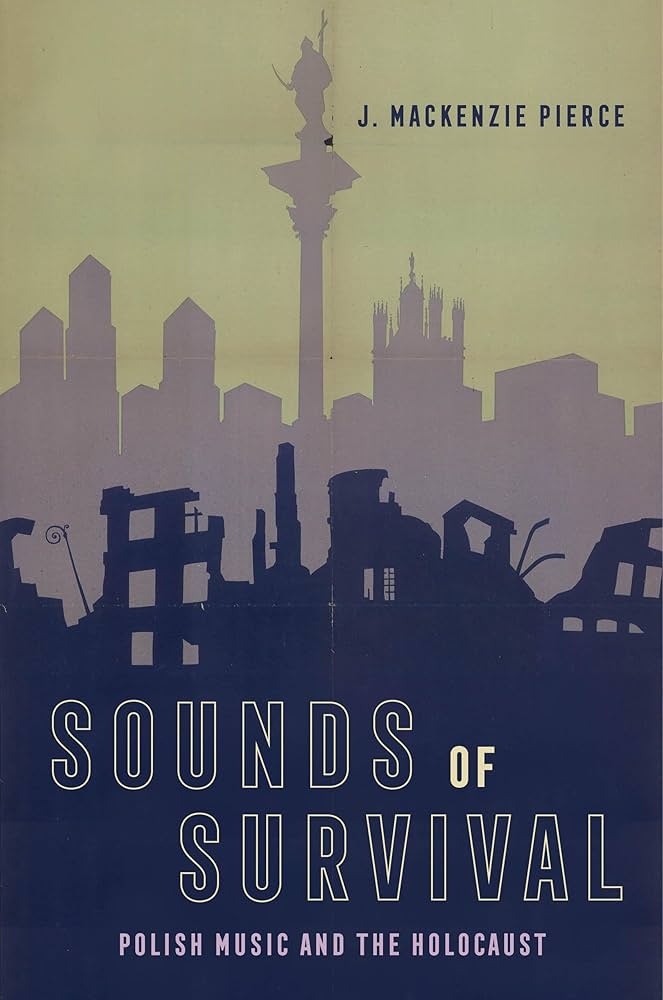
J. Mackenzie Pierce’s monograph Sounds of Survival: Polish Music and the Holocaust offers an in-depth examination of the social and political forces that shaped musical life in Poland from the 1920s through the early 1950s. Central to Pierce’s inquiry is uncovering how and why musicians, scholars, and critics who were active during these decades viewed Polish music during the Holocaust not as a rupture in the cultural development of the nation but rather as a marker of progress and continuity that continued to build into the postwar period. By reconstructing the lives and activities of Poland’s musical community, both at home and abroad, Pierce shows how a generation of musicians and scholars formed a “musical intelligentsia” that adopted narratives of continuity to reinforce a collective sense of identity and cultural resilience in the face of war trauma. However, Pierce also argues that this process of cultural reinvention marginalized Poland’s Jewish musicians, who, despite their longstanding contributions to Polish musical life, were largely excluded from these constructions of national identity.
Read the rest of this entry »Ignaz Friedman: Romantic Master Pianist. Allan Evans. Bloomington: Indiana University Press, 2009. 399 pp. ISBN 978-0-253-35310-8
 Reviewed by Jonathan D. Bellman
Familiar phrases like “Romantic Master Pianist” or the “Golden Age” of Romantic pianism (cf. an excellent recent book by Kenneth Hamilton[1]) are problematic, because they imply the existence of a single tradition shared by the giants of bygone eras. Rather, the greatest pianists of the past made their names by individuality, their independent artistic personalities and personal, often subjective interpretations of musical works that are now often normalized, more or less, into “the way this piece is played.” Foremost among these fiercely independent superpianists was Ignaz Friedman, a Polish-born Jewish virtuoso whose memory and recordings are revered by pianists but whose reputation has, unavoidably, faded somewhat. Although Friedman’s father was a peripatetic musician with limited skills at providing for his family, and his mother did most of the earning via needlework, their son’s prodigious musical gifts, which showed themselves early, were nonetheless never exploited commercially in his childhood. His family’s search for favorable circumstances meant that he would live in Poland, America, Greece, Turkey, Hungary, and Germany before going to Vienna for a university education and to complete his piano training with the renowned Theodor Leschetizky, who also trained a variety of other virtuosi. What all this meant was that Friedman would be among the best educated and most culturally well rounded of artists. Read the rest of this entry »

 Musica Judaica Online Reviews