
You are currently browsing the tag archive for the ‘klezmer’ tag.
From the Bronx to the Bosphorus: Klezmer and Other Displaced Musics of New York. Walter Zev Feldman. New York: Fordham University Press. 2025.
Reviewed by Yale Strom

Walter Zev Feldman’s From the Bronx to the Bosphorus (2025) is a hybrid work of memoir and cultural history that documents both the author’s personal trajectory and the diasporic musical traditions that shaped his career as a performer and scholar. The book does not conform to the structure of a conventional academic monograph; instead, Feldman weaves a richly layered narrative tracing his family roots, his musical education, and the many diasporic traditions he encountered in New York from the 1950s through the 1990s. During this period, immigrant cafés, clubs, and social gatherings served as vital spaces for the transmission of traditional repertoires, and Feldman positions himself as both participant and chronicler in this world.
Read the rest of this entry »56 New Klezmer Tunes for Dancing, Volume 1. Composed by Nat Seelen. New Klezmer Studios. 2023.
Reviewed by Christina Crowder

Boston-based clarinetist, bandleader, and music educator Nat Seelen has published a volume of klezmer-inspired melodies titled 56 New Klezmer Tunes for Dancing, Volume 1. The tunes are fresh and inventive, but the volume falls short in presenting tunes that could be used for Yiddish dancing. This may in part be attributed to the general revival-era decoupling of klezmer music intended for dancing from a living Jewish dance tradition as tunes were increasingly performed on the concert stage rather than mutual aid society balls or weddings. On the other hand, the 2010s brought a number of important resources online for performers and composers, including: a growing body of historical and musicological scholarship on klezmer dance music; [1] an ongoing effort within the klezmer community to teach both dance and playing for dancing; and, thousands of North American and European klezmer recordings now easily available online via the Mayrent Collection of Yiddish Recordings (University of Wisconsin, Madison), the Recorded Sound Archive (Florida Atlantic University, Boca Raton), YIVO, and other archives. While not all new klezmer compositions need to fit squarely within the traditional dance genres, when departures such as Seelen’s are intentional it serves the audience and the community writ-large to share their reasoning in notes on individual tunes or in introductory remarks. Because the folio presents the tunes specifically as dance music, this review will focus on structural analysis of tunes for danceability within the stated genre, and playability with regard to historically-informed klezmer practice in those genres rather than an evaluation of compositional issues.
Read the rest of this entry »The Oxford Handbook of Jewish Music Studies. Edited by Tina Frühauf. Oxford and New York: Oxford University Press. 2023.
Reviewed by Paul G. Feller-Simmons

The publication of The Oxford Handbook of Jewish Music Studies, edited by Tina Frühauf, marks a much-anticipated milestone. Released in November of 2023, the weighty tome attests to the rapidly changing landscape of the field, offering a comprehensive exploration of manifold subjects. With twenty-nine chapters plus an introduction penned by scholars at various stages of their careers, the Handbook truly mirrors the best facets of the field’s current state. While it would be a daunting task to do justice to every chapter within the confines of this review, particularly for an avowed early modernist such as myself, it suffices to say that the volume exudes scholarly rigor and innovation.
Read the rest of this entry »Sounding Jewish in Berlin: Klezmer Music and the Contemporary City. Phil Alexander. Oxford: Oxford University Press. 2021.
Reviewed by Zeke Levine
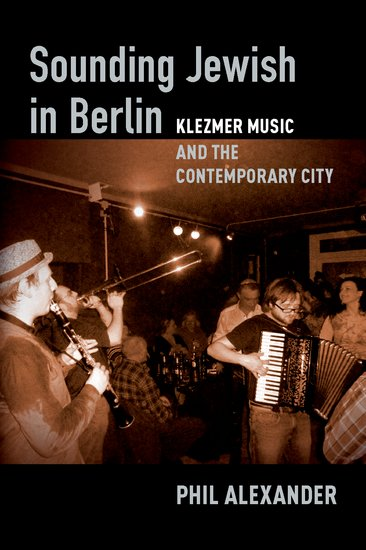
For the past two centuries, Berlin has maintained its role as a central crossroads of global politics, culture, and geography. The German capital is the focus of Phil Alexander’s Sounding Jewish in Berlin. Alexander probes the lively, yet complex contemporary Berlin klezmer scene, delving deeply into the ideological and aesthetic issues that shape it. While the klezmer revival has its roots in the United States, Alexander effectively and engagingly transports the reader to Berlin, an important locus for klezmer performance since the 1980s. Berlin, notes Alexander, is a complex setting for klezmer, given the city’s conflicted relationship with Jewish, particularly Eastern European Jewish, communities and folkways. Throughout the text, Alexander highlights thirty musicians and other creatives on the Berlin scene, framing the book around their experiences as well as his own extensive ethnographic experience as both a performer in, and keen observer of, the scene.
Read the rest of this entry »
 Musica Judaica Online Reviews