
You are currently browsing the tag archive for the ‘Holocaust’ tag.
Hitler’s Twilight of the Gods: Music and the Orchestration of War and Genocide in Europe. Alexandra Birch. Toronto: University of Toronto Press. 2025.
Reviewed by Kathryn Huether

Alexandra Birch’s Hitler’s Twilight of the Gods: Music and the Orchestration of War and Genocide in Europe presents the reader with a dramatic conceit: a Wagnerian scaffolding that traces the role of music and sound in the Nazi project from its rise (“Das Reichgold”) to its collapse (“Trauermusik”). “This is not exclusively a study of Jewish victimhood or of German perpetration,” Birch writes, “but a more nuanced understanding of expanded victim categories, shades of perpetration, the complicated role of bystanders, the archive itself, masculinities, and the Holocaust, and the soundscape of genocide” (9).
Read the rest of this entry »Sounds of Survival: Polish Music and the Holocaust. J. Mackenzie Pierce. Berkeley: University of California Press. 2025.
Reviewed by Nicolette van den Bogerd
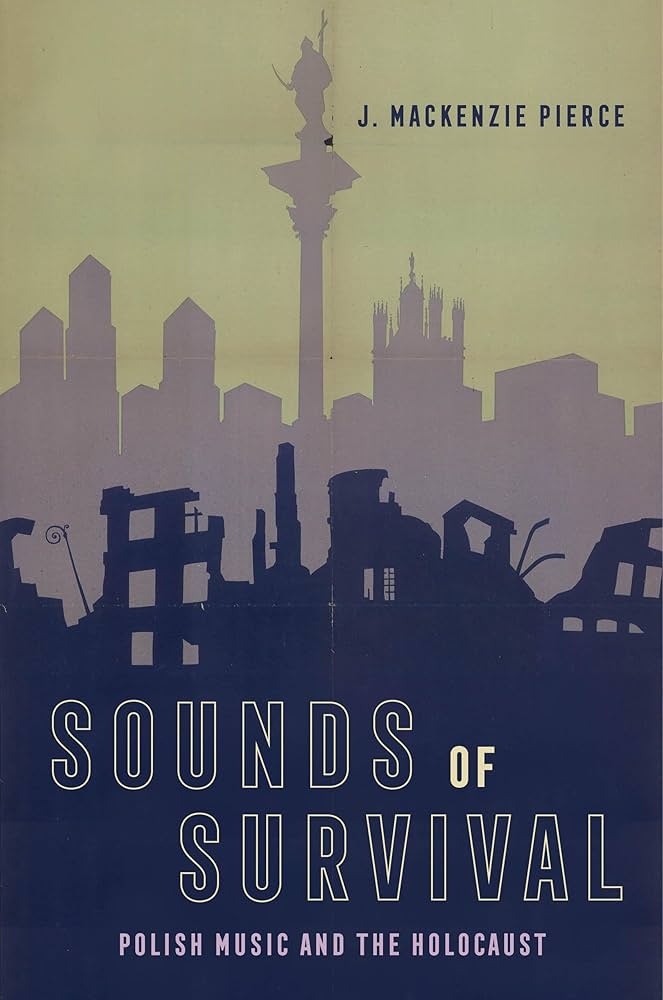
J. Mackenzie Pierce’s monograph Sounds of Survival: Polish Music and the Holocaust offers an in-depth examination of the social and political forces that shaped musical life in Poland from the 1920s through the early 1950s. Central to Pierce’s inquiry is uncovering how and why musicians, scholars, and critics who were active during these decades viewed Polish music during the Holocaust not as a rupture in the cultural development of the nation but rather as a marker of progress and continuity that continued to build into the postwar period. By reconstructing the lives and activities of Poland’s musical community, both at home and abroad, Pierce shows how a generation of musicians and scholars formed a “musical intelligentsia” that adopted narratives of continuity to reinforce a collective sense of identity and cultural resilience in the face of war trauma. However, Pierce also argues that this process of cultural reinvention marginalized Poland’s Jewish musicians, who, despite their longstanding contributions to Polish musical life, were largely excluded from these constructions of national identity.
Read the rest of this entry »Music of Exile: The Untold Story of the Composers Who Fled Hitler. Michael Haas. New Haven, CT: Yale University Press. 2023.
Reviewed by Dr. Alexandra Birch

Michael Haas’s new book is an expansion of his earlier work on Forbidden Music: The Composers Banned by the Nazis (Yale University Press: 2013) critically reconsidering different modalities of “exile” and the impact of exile on musical composition. Rather than a simple look at only those composers who fled to the United States, Haas engages with larger issues in the historiography of the Holocaust, like the material and financial ability to flee, the change in the perceived danger of Hitler across the 1930s, and how far was far enough to escape the war. Haas also complicates our understanding of those composers who remained in Europe, addressing the spectrum of complicity that they employed in order to continue working in occupied Europe. One of the strengths of the book is Haas’s experience both in performance and the humanities, where he elegantly puts the aesthetics of music in dialogue with Nazi racial and political strictures, emphasizing that denunciation and danger could be on both fronts with “Jewish” music and or a Jewish racial identity. The writing about music never feels cumbersome and is accessible to historians and musicians alike.
Read the rest of this entry »La Memoria Cantata: A Survivor from Warsaw di Arnold Schönberg nell’Europa del dopoguerra. Joy H. Calico. Edizione italiana a cura di Paolo Dal Molin, traduzione di Silvia Albesano. Milan: Il Saggiatore. 2023.
Reviewed by Jesse Rosenberg

On the list of musical works inspired by the Shoah, Arnold Schoenberg’s A Survivor from Warsaw has long held a special status. The realistic description of a roundup of Jews in the Warsaw ghetto, the concluding choral Shema that constitutes one of the strongest testimonies of Schoenberg’s re-commitment to Judaism in the last two decades of his life, and the combination of advanced twelve-tone technique with Sprechstimme, one of the composer’s earliest innovations, unite to make a powerful impression on listeners to this day. In her 2014 monograph Arnold Schoenberg’s “A Survivor from Warsaw” in Postwar Europe, dedicated to the reception of this work, Joy H. Calico documents in detail the effect of this work on European critics and audiences, and subjects it to a thorough analysis.
Read the rest of this entry »The Oxford Handbook of Jewish Music Studies. Edited by Tina Frühauf. Oxford and New York: Oxford University Press. 2023.
Reviewed by Paul G. Feller-Simmons

The publication of The Oxford Handbook of Jewish Music Studies, edited by Tina Frühauf, marks a much-anticipated milestone. Released in November of 2023, the weighty tome attests to the rapidly changing landscape of the field, offering a comprehensive exploration of manifold subjects. With twenty-nine chapters plus an introduction penned by scholars at various stages of their careers, the Handbook truly mirrors the best facets of the field’s current state. While it would be a daunting task to do justice to every chapter within the confines of this review, particularly for an avowed early modernist such as myself, it suffices to say that the volume exudes scholarly rigor and innovation.
Read the rest of this entry »Let Our Music Be Played: Italian Jewish Musicians and Composers under Fascism. Edited by Alessandro Carrieri and Annalisa Capristo. Cham, Switzerland: Palgrave Macmillan. 2021.
Reviewed by Jesse Rosenberg

The last twenty years have witnessed significant developments in scholarship concerning antisemitism in Italy during the ventennio, the twenty-year period of Fascist rule (1923-1943). Thanks to historians such as Michele Sarfatti and Giorgio Fabre, the benign view which had hitherto prevailed with regard to the antisemitic laws promulgated by the Fascist government in 1938 — that these were adapted without conviction, in adherence to the dictates of a new alliance with Germany, and represented an unexpected about-face in the treatment of Italian Jews — have been definitively rebutted. The editors of this superlative collection of essays are aware of these newly-acquired insights (one of them, Annalisa Capristo, has co-authored an important book with Fabre), but also, to judge by the variety of approaches taken by the contributors to the book, equally cognizant of the complexities involved in applying these lessons to the field of music.
Read the rest of this entry »A Jewish Orchestra in Nazi Germany: Musical Politics and the Berlin Jewish Culture League. Lily E. Hirsch. Ann Arbor: University of Michigan Press, 2010. ISBN 978-0-4721-1710-9
Reviewed for Musica Judaica Online Reviews by Barbara Milewski
 During the last two decades a formidable number of excellent studies have appeared in English and German that have given us an ever fuller picture of the compromised, politicized reality of Germany’s musical culture during the National Socialist period. Lily Hirsch’s book, A Jewish Orchestra in Nazi Germany: Musical Politics and the Berlin Jewish Culture League, is a valuable contribution to this body of knowledge.
Hirsch draws on previous scholarship published in Germany—notably Henryk Broder and Eike Geisel’s Premiere und Pogrom: der Jüdische Kulturbund 1933-1941, and Geschlossene Vorstellung: Der Jüdische Kulturbund in Deutschland 1933-1941 published in conjunction with a 1992 exhibit at Berlin’s Akademie der Künste, which houses the Kulturbund archives—and significantly expands on this material through interviews with League members and subsequent archival investigations. In so doing, she makes available to Anglophone readers for the first time a comprehensive and nuanced telling of the origins and activities of the Jüdischer Kulturbund, or Jewish Culture League, the self-imagined, Nazi sanctioned, Jewish cultural organization that staged musical and theatrical performances for Jewish audiences in Nazi Germany between 1933 and its disbanding in 1941. As Hirsch’s study makes clear, the League’s history remains one of the more poignant examples of the complex, ever-narrowing field of choices Germany’s Jews were forced to navigate after the Nazis assumed power and enacted anti-Jewish exclusionary legislation (intended to protect the purity of Aryan culture) that restricted all aspects of their public and private lives.
The Pope’s Maestro. Gilbert Levine. San Francisco: Jossey-Bass, 2010. 456 pp. + DVD. ISBN 978-0-4704-9065-5
Reviewed by John T. Pawlikowski

At the beatification of the late Pope John Paul II on May 1, 2011, a Brooklyn-born Jewish orchestra conductor had an honored seat in the audience. How this came to be for a traditional Jew with little prior contact with Catholic religious leaders is the basic narrative of this volume told from a first person perspective by Levine.
Levine’s grandparents emigrated to the United States from Poland. His mother-in-law is a survivor of Auschwitz. He has been a distinguished conductor who has performed with leading orchestras in North America, Europe, and Israel. In 1987 Levine was invited to serve as a guest conductor of the Krakow Philharmonic for one week. This is where his story begins. Read the rest of this entry »
Music in Terezín 1941-1945. Joža Karas. 2nd ed. Hillsdale, NY: Pendragon Press, 2009. ISBN 978-1-5764-7030-5
The Wonder and the Grace of Alice Sommer Herz: Everything is a Present. Dir. Christopher Nupen. DVD and Liner Notes. Allegro Films, 2009.
Reviewed by Shirli Gilbert
Shortly before his death in December 2008 Joža Karas completed the second edition of his book Music in Terezín 1941-1945, the culmination of a life’s work. When the book was originally published in 1985 it was path-breaking, documenting a largely unknown chapter in the history of the Holocaust: the lively and wide-ranging musical life in the “model ghetto” Terezín (in Czech, Theresienstadt in German). When Karas began his work as a “modest summer project” in 1970 (ix), very little music from the ghetto had been uncovered, and even less had been written about it. Karas, a Czech researcher and musician based in Connecticut, devoted the rest of his life to passionately researching the subject, conducting interviews across Europe, Israel, and the United States, undertaking archival research, and transcribing scores. In addition to publishing his book, he lectured widely on the subject, produced performing editions, and tirelessly promoted Terezín compositions in performances with his own string quartet, established expressly for that purpose. Karas himself conducted the American premiere of Brundibár in 1975 and the world premiere of the English version (in his own translation) in 1977. In short, the subject of music in Terezín has become well known among Western audiences thanks in large part to Karas’s pioneering efforts. Read the rest of this entry »
Jewish Music and Modernity. Philip V. Bohlman. New York: Oxford University Press/AMS Studies in Music, 2008. xxxiii + 280 pp. ISBN 978-0-1951-7832-6
Reviewed by Lisa Parkes
Discourse about “Jewish music” has traditionally raised complex questions about the identity of “Jewishness” in music. The ontology of “Jewish music” in modern Jewish history is as elusive as the nature of music itself. The reason for this, as Philip Bohlman argues in Jewish Music and Modernity, is that Jewish music in modernity exists not within a definable space or time, but rather at moments of disjuncture – in between regions, amid moments of transition and transformation, and at the border of ethnic, religious, and social boundaries. Jewish music, as an aesthetically autonomous object in Jewish society, was conceived of for the first time at the modernist moment, when Jews entered the public sphere of modern European society, broadening the purely ritualized devotional function that music formerly served. But the structural transformation that modernity brought about in musical culture had the paradoxical effect of confounding the very notion of “Jewish” music. Exposed to modern musical practices and genres in the non-Jewish public sphere during a period of political and aesthetic transformation, Jewish music became “Jewish” precisely in its confrontation with non-Jewish genres, forms, languages, and performers. Bohlman demonstrates that Jewish music, in responding to the political and aesthetic challenges of modernity, is inherently hybrid, unstable, and dynamic. It represents a dynamic site where national, ethnic, and gender identities are constructed and contested. Thus, borders between Jewish and non-Jewish became permeable, so that “musical repertories that for some were entirely Jewish—say, cabaret at the turn of the twentieth century—were not the least bit Jewish for others” (xvii). In other words, music participated in the transformation of modern Jewish identity itself.
Read the rest of this entry »

 Musica Judaica Online Reviews