
You are currently browsing the tag archive for the ‘Europe’ tag.
Hitler’s Twilight of the Gods: Music and the Orchestration of War and Genocide in Europe. Alexandra Birch. Toronto: University of Toronto Press. 2025.
Reviewed by Kathryn Huether

Alexandra Birch’s Hitler’s Twilight of the Gods: Music and the Orchestration of War and Genocide in Europe presents the reader with a dramatic conceit: a Wagnerian scaffolding that traces the role of music and sound in the Nazi project from its rise (“Das Reichgold”) to its collapse (“Trauermusik”). “This is not exclusively a study of Jewish victimhood or of German perpetration,” Birch writes, “but a more nuanced understanding of expanded victim categories, shades of perpetration, the complicated role of bystanders, the archive itself, masculinities, and the Holocaust, and the soundscape of genocide” (9).
Read the rest of this entry »Sounds of Survival: Polish Music and the Holocaust. J. Mackenzie Pierce. Berkeley: University of California Press. 2025.
Reviewed by Nicolette van den Bogerd
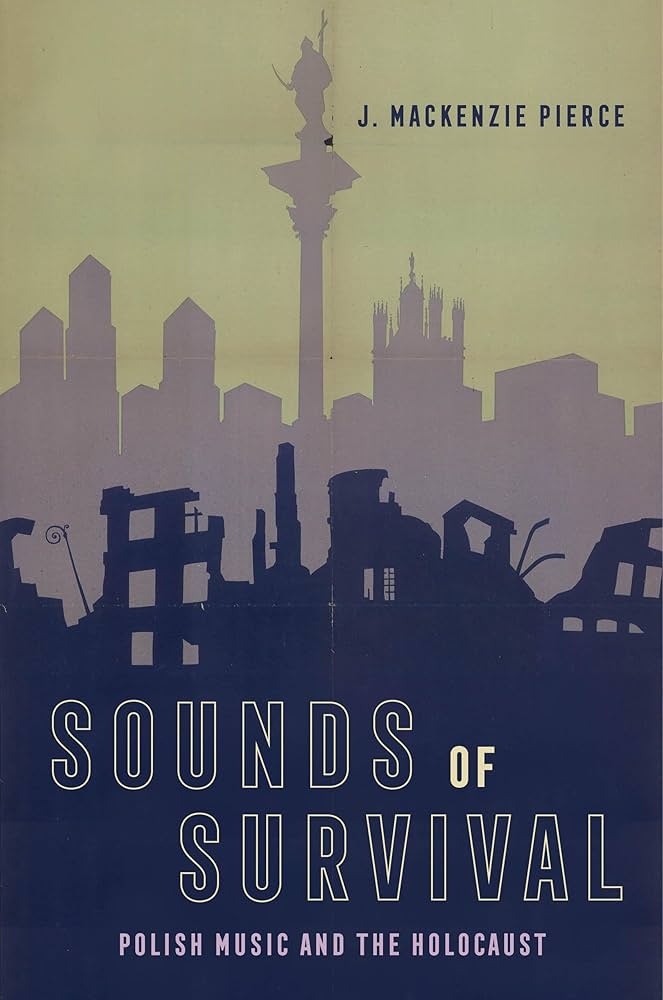
J. Mackenzie Pierce’s monograph Sounds of Survival: Polish Music and the Holocaust offers an in-depth examination of the social and political forces that shaped musical life in Poland from the 1920s through the early 1950s. Central to Pierce’s inquiry is uncovering how and why musicians, scholars, and critics who were active during these decades viewed Polish music during the Holocaust not as a rupture in the cultural development of the nation but rather as a marker of progress and continuity that continued to build into the postwar period. By reconstructing the lives and activities of Poland’s musical community, both at home and abroad, Pierce shows how a generation of musicians and scholars formed a “musical intelligentsia” that adopted narratives of continuity to reinforce a collective sense of identity and cultural resilience in the face of war trauma. However, Pierce also argues that this process of cultural reinvention marginalized Poland’s Jewish musicians, who, despite their longstanding contributions to Polish musical life, were largely excluded from these constructions of national identity.
Read the rest of this entry »Leone Sinigaglia 1868-1944: Spoliazione e Morte di un Compositore Ebreo Perseguitato dal Fascismo. Marco Fiorentino. Turin: Italy. Silvio Zamorani Editore. 2024.
Reviewed by Jesse Rosenberg

In the early twentieth century the Turinese composer Leone Sinigaglia reached a measure of popularity inside and outside of Italy mainly on the strength of a handful of instrumental works. He was also identified with research into folk songs of his native Piedmont region, which he came to know “from the mouth of the people” (as he claimed in the dedication of his folk song collection Vecchie Canzoni Popolar del Piemonte) during excursions into the countryside, and of which he published a number of arrangements. But the days when works such as his concert overture Le Baruffe Chiozzotte appeared on concert programs and radio broadcasts are long gone. In recent years the music of Sinigaglia has undergone a reappraisal, and a fair selection of his works has been recorded. A modest-sized monograph devoted to Sinigaglia appeared in 2012. [1] The reasons for this are not exclusively musical. The proportion is impossible to quantify with any precision, but at least part of this renewed interest is the fact that Sinigaglia was a victim of the Holocaust.
Read the rest of this entry »The Moralization of Jewish Heritage in Germany: Sustaining Jewish Life in the Twenty-First Century. Sarah M. Ross. Lanham, MD: Lexington Books. 2024.
Reviewed by Kira Álvarez

Many Germans today regard the preservation of Jewish heritage as a moral responsibility. In The Moralization of Jewish Heritage in Germany: Sustaining Jewish Life in the Twenty-First Century, German ethnomusicologist Sarah M. Ross examines how this responsibility has been addressed. She does this by exploring German Reform and Minhag Ashkenaz synagogue music, examining the roles of both Jewish and non-Jewish stakeholders in contemporary Germany. She highlights the creation of a “community of shared values” based on moral responsibility and feelings of belonging. However, Ross demonstrates that these shared values often reveal more about non-Jewish German society than Jewish society. She argues that Germany’s devotion to moralizing Jewish heritage often leads to an overly static understanding of Judaism and Jewish life, influenced by its Christian surroundings and largely confined to the past. Ross brings new insights to the topic of Jewish heritage in Germany, often regarded as a subject already comprehensively researched. She offers a perspective that is both original and urgent for our current times.
Read the rest of this entry »Time’s Echo: The Second World War, the Holocaust, and the Music of Remembrance. Jeremy Eichler. New York, NY: Alfred A. Knopf. 2023.
Reviewed by Karen Painter

Jeremy Eichler makes a passionate case that as we approach a world without living memory of the Holocaust, there is an “ethical imperative” to attend to “musical memorials” which summon “our commitment to witness” (pp. 174–175). Written when Eichler was classical music critic for the Boston Globe, Time’s Echo bears the fruits of his profession everywhere in eloquent and astute description of music that matters deeply to him. A historian who wrote his dissertation on Schoenberg’s A Survivor from Warsaw, Eichler undertakes the ambitious task of showing how music became so important to German Jews, which finds him starting his story in the Enlightenment, tracing the ideal of Bildung (cultivation) across Central European history. The book’s subtitle notwithstanding, we arrive at World War II only in chapter four out of ten.
Read the rest of this entry »Music of Exile: The Untold Story of the Composers Who Fled Hitler. Michael Haas. New Haven, CT: Yale University Press. 2023.
Reviewed by Dr. Alexandra Birch

Michael Haas’s new book is an expansion of his earlier work on Forbidden Music: The Composers Banned by the Nazis (Yale University Press: 2013) critically reconsidering different modalities of “exile” and the impact of exile on musical composition. Rather than a simple look at only those composers who fled to the United States, Haas engages with larger issues in the historiography of the Holocaust, like the material and financial ability to flee, the change in the perceived danger of Hitler across the 1930s, and how far was far enough to escape the war. Haas also complicates our understanding of those composers who remained in Europe, addressing the spectrum of complicity that they employed in order to continue working in occupied Europe. One of the strengths of the book is Haas’s experience both in performance and the humanities, where he elegantly puts the aesthetics of music in dialogue with Nazi racial and political strictures, emphasizing that denunciation and danger could be on both fronts with “Jewish” music and or a Jewish racial identity. The writing about music never feels cumbersome and is accessible to historians and musicians alike.
Read the rest of this entry »La Memoria Cantata: A Survivor from Warsaw di Arnold Schönberg nell’Europa del dopoguerra. Joy H. Calico. Edizione italiana a cura di Paolo Dal Molin, traduzione di Silvia Albesano. Milan: Il Saggiatore. 2023.
Reviewed by Jesse Rosenberg

On the list of musical works inspired by the Shoah, Arnold Schoenberg’s A Survivor from Warsaw has long held a special status. The realistic description of a roundup of Jews in the Warsaw ghetto, the concluding choral Shema that constitutes one of the strongest testimonies of Schoenberg’s re-commitment to Judaism in the last two decades of his life, and the combination of advanced twelve-tone technique with Sprechstimme, one of the composer’s earliest innovations, unite to make a powerful impression on listeners to this day. In her 2014 monograph Arnold Schoenberg’s “A Survivor from Warsaw” in Postwar Europe, dedicated to the reception of this work, Joy H. Calico documents in detail the effect of this work on European critics and audiences, and subjects it to a thorough analysis.
Read the rest of this entry »Jerusalem: Blake, Parry, and the Fight for Englishness. Jason Whittaker. Oxford, UK: Oxford University Press. 2022.
Reviewed by Benjamin Wolf

This is a book about a single poem and a single song: William Blake’s poem, Jerusalem (“And did those feet in ancient time walk upon England’s mountains green”), and Hubert Parry’s famous setting of it. This combination of words and music has been central to British (perhaps it is better to say English) cultural life since Parry’s composition was first performed in 1916. Although originally composed for “Fight for Right,” an organization that supported Britain’s war efforts, it was subsequently adopted by the women’s suffrage movement, the Women’s Institute, and by figures on both the left and right of the political spectrum. Jason Whittaker traces this history, and the possible cultural meanings of both Blake’s poem and Parry’s setting of it, over a two-hundred-year period, ending in the Britain of the 2011 royal wedding, the 2012 Olympic Games and the 2016 Brexit referendum. Where British musical history is concerned, this book takes a valuable place alongside others such as Andrew Blake’s The Land without Music or Hughes and Stradling’s more cynical The English Musical Renaissance 1840 – 1940. [1]
Read the rest of this entry »Let Our Music Be Played: Italian Jewish Musicians and Composers under Fascism. Edited by Alessandro Carrieri and Annalisa Capristo. Cham, Switzerland: Palgrave Macmillan. 2021.
Reviewed by Jesse Rosenberg

The last twenty years have witnessed significant developments in scholarship concerning antisemitism in Italy during the ventennio, the twenty-year period of Fascist rule (1923-1943). Thanks to historians such as Michele Sarfatti and Giorgio Fabre, the benign view which had hitherto prevailed with regard to the antisemitic laws promulgated by the Fascist government in 1938 — that these were adapted without conviction, in adherence to the dictates of a new alliance with Germany, and represented an unexpected about-face in the treatment of Italian Jews — have been definitively rebutted. The editors of this superlative collection of essays are aware of these newly-acquired insights (one of them, Annalisa Capristo, has co-authored an important book with Fabre), but also, to judge by the variety of approaches taken by the contributors to the book, equally cognizant of the complexities involved in applying these lessons to the field of music.
Read the rest of this entry »Sonic Ruins of Modernity: Judeo-Spanish Folksongs Today. Edwin Seroussi. London: Routledge. 2023.
Reviewed by Lori Sen

A minority within the Jewish people, Sephardim are a triple diasporic population, who carried with them their culture, traditions, language (Judeo-Spanish), and oral literature. Judeo-Spanish folksongs are among the Sephardim’s oral literature and reflect the diverse influences of the many cultures they encountered throughout their five-hundred-year-long journey from medieval Iberia to all over the modern world. With Sonic Ruins of Modernity, musicologist Edwin Seroussi introduces the contemporary concept of folksong (in the post-tradition era) as a sonic ruin, regularly visited by tourists interested in exploring the history of other cultures.
Read the rest of this entry »
 Musica Judaica Online Reviews