The Organ and Its Music in German-Jewish Culture. Tina Frühauf. New York: Oxford University Press, 2009.  296 pp.  ISBN 978-0-1953-3706-8

Reviewed by Assaf Shelleg

Recent studies in Jewish art music have contributed significantly to an emerging continuum of Jewish identities in Western music, from the St. Petersburg Society for Jewish Folk Music, to Ernest Bloch’s “Jewish cycle,” to Leonard Bernstein’s symphonies[1]. Dealing with the migration of  liturgical and paraliturgical Jewish musics into Western art music, these studies try to assimilate “Jewish music” into the expanding canon of Western music while struggling with both the historical lagging of Jewish musical literacy and the pitfalls of essentialism. In the process, scholars find themselves harassed by the many sonic stereotypes that connote with “Jewish music” and are in urgent need of dispelling. Tina Frühauf’s book highlights such a stereotype, but in an inversion: the introduction of the organ, regarded emblematically as Christian (3), into the synagogue and the way it stimulated liturgical, paraliturgical, and art music—even as it “remained an oddity for Jews and non-Jews alike” (viii).
Read the rest of this entry »

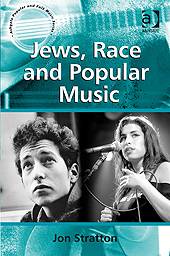
Jews, Race and Popular Music. Jon Stratton. Burlington, VT: Ashgate, 2009. 238 pp. ISBN 978-0-7546-6804-6

Reviewed by Ari Y. Kelman

In Jews, Race and Popular Music, Jon Stratton attempts to stage an intervention at the fulcrum of the peculiar relationship between Jews and popular music. The historical coincidence of Jewish people and African American musical styles—from Al Jolson to Amy Winehouse—has become something of a cottage industry both in and beyond the university (Stratton includes a comprehensive listing of titles in his introduction). In this work, Stratton is trying to reframe this well-documented yet still vexing area of research through the lenses of race and performance. The trouble is that he offers an argument that tries so hard to deconstruct Jewishness that he ends up reifying it.

Read the rest of this entry »

(To maintain standards of academic integrity, the regular editor of Musica Judaica Online Reviews has removed himself from the review process for this book.  Mark Kligman, co-editor of the Musica Judaica journal, has graciously stepped in as guest editor. -Ed.)

The Making of a Reform Jewish Cantor: Musical Authority, Cultural Investment. Judah M. Cohen. Bloomington: Indiana University Press, 2009. 272 pp. + CD.  ISBN 978-0-2533-5365-8

Reviewed by Scott M. Sokol

In the midst of a promising career as a scientist and academic neuropsychologist, I made the unusual decision to go back to school (at the Jewish Theological Seminary) to study for the cantorate. My department chair at the time made the off-handed comment in an interview that it was like watching your child go off to the circus (this from a knowledgeable Jew who often served as a lay “cantor” in his synagogue). Why did I need to go to cantorial school? After all, many years of Jewish education and especially Jewish camping had left me with a very good working knowledge of cantillation and nusach ha-t’fillah; I was a classically trained musician and had a good voice. What more did I need? My response to that common set of questions has remained the same to this day—namely, that I wanted to be an authentic cantor, an authority on synagogue liturgy and music, and I felt the only way to truly achieve that goal was through seminary study, and eventual investiture by a religious body.

Read the rest of this entry »

Leo Zeitlin: Chamber Music. Paula Eisenstein Baker and Robert S. Nelson, eds. Middleton, WI: A-R Editions, 2009. lxxxiv+199 pp. ISBN 978-0-89579-645-5

Reviewed by Lyudmila Sholokhova

Leo Zeitlin’s life and music became a subject of Paula Eisenstein Baker’s research about twenty years ago. Fascinated by Zeitlin’s masterpiece “Eli Zion” for cello and piano, Eisenstein Baker, a cellist with a keen interest in musicology, started to investigate the life and works of this remarkable, but almost unknown, composer. Her research has resulted in this publication of Zeitlin’s chamber music compositions, which is accompanied by a carefully reconstructed biography of the composer, a critical study of his works, and a comprehensive presentation of text settings from the vocal works in Yiddish, Hebrew and Russian.

Read the rest of this entry »

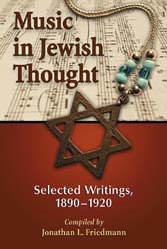
Music in Jewish Thought: Selected Writings, 1890–1920. Jonathan L. Friedmann, comp. Jefferson, NC: McFarland & Company, 2008. 212 pp. ISBN 978-0-7864-4439-7

The Value of Sacred Music: An Anthology of Essential Writings, 1801–1918. Jonathan L. Friedmann, comp. Jefferson, NC: McFarland & Company, 2008. 186 pp. ISBN 978-0-7864-4201-0

Reviewed by Geoffrey Goldberg

Although the study of Jewish music as a scholarly discipline is still comparatively recent, the publication of two anthologies of older musical thought highlights how the field has matured. The first work is a collection of essays written between the death of Salomon Sulzer (1804–1890), the cantor-composer “rejuvenator” of Ashkenazic synagogue music, and the emergence after World War I of Abraham Z. Idelsohn (1882–1938), the first academically recognized musicologist and ethnomusicologist of Jewish music. What Sulzer and Idelsohn shared in common, according to Friedmann, was a romantic notion of Judaism’s musical past. Just as Sulzer strove “to discover and present ‘purified’ [Ashkenazic] Jewish music” (8), so Idelsohn sought “to uncover unifying elements contained in the music of all Jewish communities, no matter how disparate” (15). The achievements of both engendered a sense of pride in the continuity of Judaism’s religious and cultural past and the Jewish people’s place in the post-Emancipation present.

Read the rest of this entry »

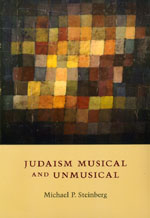
Judaism Musical and Unmusical. Michael P. Steinberg. Chicago: University of Chicago Press, 2007. 270 pp. ISBN 978-0-2267-7195-3

Reviewed by Tina Frühauf

In Judaism Musical and Unmusical, Michael P. Steinberg takes the reader on a journey through predominantly but not exclusively Central European Jewish history and culture in the nineteenth and twentieth centuries, at times privileging music as a focal point of cultural discourse. The eight essays in this volume, most of which have been published before, are loosely connected musings about the different facets of modernity and Judentum, and involve the concepts of memory, secularity, and aesthetics, among others. In each chapter Steinberg weaves different threads together, from art to psychoanalysis, from architecture to music. Steinberg’s book, which in a larger sense is a discourse about identity and Judaism, begins with an essay on Edward Said and his propositions of Jewish identity, and follows with individual case studies of known intellectuals and their work. Steinberg traces the subject of Judaism in Sigmund Freud’s late classic Moses and Monotheism and in the writings of Henry James, Eduard Fuchs, and Walter Benjamin; and he explores the intellectualism of Italian Jewish historian Arnaldo Momigliano. Further chapters center on the artist Charlotte Salomon and her Life? or Theater? and Leonard Bernstein in Vienna. The journey ends in Berlin with a critique of its Jewish Museum and an assessment of some recent scholarship on German Jewish subjects, which cannot compensate for the absence of a full bibliography at the end of the book.

Read the rest of this entry »

Perspectives on Jewish Music: Secular and Sacred. Jonathan L. Friedmann, ed. Lanham, MD: Lexington Books, 2009. 162 pp. ISBN 978-0-7391-4152-6

Reviewed by Joshua S. Walden

Perspectives on Jewish Music, a collection of five essays addressing music in contemporary Jewish culture and personal Jewish history, is edited by Jonathan L. Friedmann, a cantor, string player, and author. In his introduction, Friedmann describes music as a tool of cultural preservation and emphasizes the role of music performance in defining Jewish personal and group identities throughout the Diaspora. Because of the many different contexts and conditions of Jewish life in the twentieth century, music has played a variety of roles and reflects a broad diversity of influences. This multiplicity of Jewish musical experiences is reflected in the disparate subjects of the book’s chapters.

Read the rest of this entry »