The Socalled Movie (2010).  Dir. Garry Beitel.  Prod, Barry Lazar (reFrame Films) & Ravida Din (The National Film Board of Canada). 86 min.

Reviewed by Louis KaplanThe Socalled Movie

In dispensing with the pretext of a continuous narrative and dividing his biopic on Josh Dolgin into eighteen parts to create a fragmented and kaleidoscopic portrait of this multi-faceted Montreal musician, Garry Beitel’s The Socalled Movie has made a symbolic statement that registers in a Jewish key.  For the structure of the film signals in Jewish numerological terms (where Chai/Life = 18) that it is the superabundance of life itself with all of its gusto and exuberance that this project seeks to capture in documenting the on- and off-stage antics of its restless musical subject.  Tracking Dolgin at home and on tour, the film illustrates how he has blended the genres of klezmer, hip hop, and funk into a potent and often rambunctious mix. Read the rest of this entry »
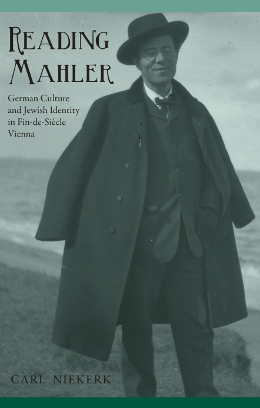

Reading Mahler:  German Culture and Jewish Identity in Fin-de-Siècle Vienna. Carl Niekerk.  Rochester, NY:  Camden House, 2010.  ISBN 978-1-5711-3467-7

Reviewed by John J. SheinbaumReading Mahler

For a composer once considered to be on the margins of the Germanic symphonic tradition, Gustav Mahler (1860-1911) now enjoys an enormous discography, an ever-expanding corpus of biographical and musicological scholarship, and nothing short of a cult of followers ready to discuss and debate any detail that might suggest new paths to interpreting his lengthy and emotionally involving works.[1]  Carl Niekerk’s Reading Mahler is a notable addition to the composer’s bibliography because it counters conventional images of Mahler as a “nostalgic modernist” or a “neoromanticist” derived from the first-person recollections of the composer’s wife, Alma, and the conductor Bruno Walter. Niekerk instead places Mahler at the head of the “avant-garde” generation of composers that followed (212).  This is a Mahler concerned with nothing less than “reinventing the German cultural tradition” in a way distinct from the nationalist models most closely associated with the influential anti-Semitic opera composer Richard Wagner (218).  For Niekerk, then, Mahler’s “Jewishness is of importance, even though he said little about it in public” (12), and even though it plays little more than a background role in philosopher Theodor Adorno’s essential monograph on the composer.[2]  His reconsideration of Mahler thus encompasses much more than musical issues per se.  Niekerk aims to place Mahler securely within the intellectual context of his time by focusing on the texts that may have been formative in his thinking, and that often played direct roles in the construction of his songs and symphonies. Read the rest of this entry »
The Naming. Galeet Dardashti. Galeet Dardashti, 2010.

Reviewed by Sarah Imhoff

In the Genesis creation account God speaks and the world springs into existence, light and dark, water and sky, earth and seas. The voice is coextensive with creation. Galeet Dardashti’s new recording The Naming can claim no such miraculous speech acts, but her music recalls both the creative power of the voice and a near-divine ability to bring women to life.

Dardashti’s Persian-Jewish heritage and academic training come together in a beautiful and yet theologically provocative recording. The music is at once traditional and radical: the first song begins with the prayer for laying tefillin but in a woman’s voice, while “Dinah” incorporates a traditional Moroccan piyyut, and “Sarah/Hagar” includes recent Hebrew and Arabic headlines about political violence. At times Dardashti employs a Mizrahi cantorial style, to which her rich voice brings depth and emotion. Even her own personal lineage leaves an imprint on the sound: her father, cantor Farid Dardashti, sings in “Endora.” Perhaps the most striking moments in the recording, however, are in the songs composed of biblical verses. Their radical character lies not simply in the verses themselves, but rather in Dardashti’s midrashic construction of the songs: the presence, absence, order, and juxtaposition of verses can ultimately be read as bold reinterpretations of the power, the agency, and the simple humanity of the biblical women. Read the rest of this entry »

Working With Bernstein: A Memoir. Jack Gottlieb.  New York: Amadeus Press, 2010.  ISBN 978-1-5746-7186-5

Reviewed by Barry Seldes Working with Bernstein

In 1958, Leonard Bernstein, recently appointed music director of the New York Philharmonic, hired as his assistant Jack Gottlieb, a composer with a Ph.D dissertation on Bernstein’s music.  Gottlieb’s job description seemed indeterminate: from vetter of compositions sent to Bernstein for potential performance to general “gopher.” In this latter capacity, Gottlieb traveled the globe with the peripatetic maestro, seeing to Bernstein’s toiletries, packing his bags, managing transportation, and otherwise working hard but, in Bernstein’s company, having a thoroughly good time.  Apparently Gottlieb performed splendidly, and, save for four years when he took a position teaching composition, he remained at Bernstein’s side until Bernstein’s death in 1990. No doubt, the friendship that ensued was cemented by shared Jewish faith and Gottlieb’s extraordinary competence in understanding Bernstein’s music. Indeed, Bernstein would come to entrust Gottlieb with writing the program notes and commentaries to accompany the published scores, recordings and performances of Bernstein’s own music. Now Gottlieb, some twenty years after Bernstein’s death, has written this work, Part I of which is a memoir of his experiences with Bernstein, and Part II of which contains his collected program notes and commentaries. Read the rest of this entry »

The Schenker Project: Culture, Race and Music Theory in Fin-de-Siècle Vienna.  Nicolas Cook.  New York:  Oxford University Press, 2007. xi + 355 pp.  ISBN 978-0-1997-4429-9

Reviewed by Alison Rose

The cultural developments of fin-de-siècle Vienna have been the subject of several historical monographs. Alan Janik and Stephen Toulmin’s Wittgenstein’s Vienna, originally published in 1973, was followed by Carl Schorske’s Fin-de-Siècle Vienna: Politics and Culture in 1980. Works by Marsha Rozenblit, Steven Beller, and Robert Wistrich focused attention on the Jews of Vienna, emphasizing the importance of the Jewish contribution to Viennese culture. One thing that these works hold in common is their inclusion of Viennese Jewish composer Arnold Schoenberg, and omission of his contemporary, Viennese Jewish music theorist Heinrich Schenker.  This is all the more perplexing when one considers how influential Schenkerian theory was to become in the United States. Schenker, unlike Schoenberg, did not convert to Christianity: he remained a loyal (if concealed) Jew throughout his life, and he somewhat oddly seems to have embraced both his Jewishness and German nationalism.  Nicolas Cook’s book provides some hints as to how this worldview developed, and more importantly, it restores Schenker to his rightful place in fin-de-siècle Viennese culture. However, the book falls short of accounting for the rather peculiar omission of Schenker from most previous studies on the period. Read the rest of this entry »

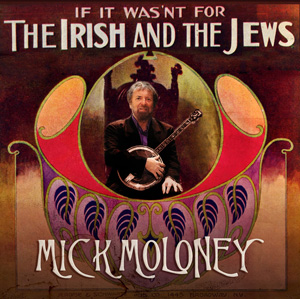
If It Wasn’t for the Irish and the Jews.  Mick Moloney. Compass Records, 2009.

Reviewed by Stephen WattIf it Wasn't for the Irish and the Jews

I first enjoyed Mick Moloney and The Green Fields of America some twenty years ago at a national meeting of the American Conference for Irish Studies.  Moloney, a talented musician-singer and folklorist who is also a Professor of Music and Irish Studies at New York University, formed the group in the later 1970s and, at least in my memory of the evening, offered a program in which traditional reels, jigs, and step dancing predominated.  In the past few years, however, Moloney’s considerable energies have been directed more specifically at America’s Tin Pan Alley era, a time in which Irish and Jewish songwriters—separately and collaboratively—created a popular music expressive of some of the moment’s most pervasive social issues: the struggles of newly arrived immigrants, their often tense internal negotiations between assimilation and nostalgia, and the specter of World War I.  Moloney’s earlier album McNally’s Row of Flats (Compass, 2006) treats the highly successful collaboration of Edward Harrigan and David Braham; thus, If It Wasn’t for the Irish and the Jews might be regarded as a further iteration of Moloney’s fascination with American popular music between 1880 and 1920. Read the rest of this entry »

Herencia Judía. Benjamin Lapidus. Tresero Productions, 2008.

Timba Talmud. Roberto Rodriguez/Sexteto Rodriguez. Tzadik, 2009.

Reviewed by Lillian WohlTimba Talmud

Herencia Judía and Timba Talmud are recordings that fuse Afro-Caribbean (mainly Cuban) and Jewish (Ashkenazic and Sephardic) traditions. While Roberto Rodriguez/Sexteto Rodriguez’s compilation is largely dance music derived from popular Cuban and klezmer repertoire to be enjoyed in the home or in secular engagements, Lapidus’s album takes on the difficult task of arranging piyyutim (paraliturgical hymns) and texts from Jewish holidays with secular and religious musics of the Spanish Caribbean. Lapidus and Rodriguez’s impressions of musical encounter are presented as audiotopias—ideological spaces that offer the listener and/or the musician new maps for re-imagining the present social world.[1] They are spaces with no real place where ideological contradictions and conflicts may coexist.[2] Yet, the proliferation of a variety of Cuban musical idioms such as rumba, son, cha-cha-chá, mambo, and comparsa assure a focus on Cuban sound on both albums. Ultimately, by playing with musical materials from Afro-Caribbean, Cuban, and Jewish traditions, both Lapidus and Rodriguez must contend with the difficulties of finding a coherent musical point of view. In this respect, Rodriguez more successfully streamlines his vision, maintaining a focus on (predominantly) popular styles and images in comparison to Lapidus, whose strategy can feel almost overwhelmingly eclectic at times. Read the rest of this entry »

Playing Across a Divide: Israeli-Palestinian Musical Encounters. Benjamin Brinner. New York: Oxford University Press, 2009. 360 pp. ISBN 978-0-1953-9594-5

Reviewed by Arieh Saposnik

Some time in the late 1980s, at the height of the first Palestinian intifada, Israeli poet/lyricist/author/publicist Jonathan Geffen devoted one of his regular newspaper columns to Israeli music. Geffen, renowned as an eloquent cynic in his often dour critique of Israeli society, began his piece by articulating the general sense of shock and depression that had taken over much of Israeli cultural and intellectual life in that period, particularly among those identified with the country’s left-of-center political camp, for which Geffen was a spokesperson. Depressing though the situation was, Geffen wrote, there was one bright spot: In a country so small and crisis-ridden, the extent and range of musical creativity was to him a small piece of veritable redemption. Read the rest of this entry »

Songs of Peace. Rabbi Shlomo Carlebach. Sojourn Records, 2010.

Higher & Higher. Neshama Carlebach and The Green Pastures Baptist Choir. Sojourn Records, 2010.

Reviewed by Shaul MagidSongs of Peace

Jewish ethnomusicology in its current form is a relatively new field. In the past few decades there has been a flurry of studies and reviews that have dealt with the origins of Jewish music and various ethnic musical traditions, including American Jewish music. It therefore seems somewhat surprising that (as far as I know) there has been little work published on the prolific and influential musical career of Rabbi Shlomo Carlebach, arguably the most well-known composer and performer of traditional Jewish music in the post-war period.

Below I review two very different Carlebach compilations. The first, Songs of Peace, includes selections from two previously unreleased live performances in 1973. The second, Higher & Higher, represents another branch of the Carlebach industry: the work of his interpreters, in this case his eldest daughter Neshama Carlebach. Read the rest of this entry »

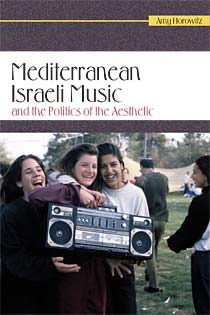
Mediterranean Israeli Music and the Politics of the Aesthetic. Amy Horowitz. Detroit: Wayne State University Press, 2010. xvii+251 pp. (+ 19 songs on CD). ISBN 978-0-8143-3465-2

Reviewed by Motti RegevMediterranean Israeli Music and the Politics of the Aesthetic

Musiqa mizrahit, aka Israeli Mediterranean Music, is a category of popular music mostly known for its strong Middle Eastern and Greek tinges. It has been at the center of Israeli public discourse on popular music since the late 1970s. By 2010, the leading theme of this discourse is the “triumph” of the genre in the field of Israeli popular music. With prominent performers such as Sarit Hadad, Eyal Golan, Kobi Peretz, Moshe Peretz, Shlomi Shabat, Lior Narkis and others filling up the largest music venues in Israel, leading the sale charts and ruling the radio airwaves, Israeli Mediterranean Music is by 2010 the “mainstream” of Israeli popular music. Throughout its history, speakers for Israeli Mediterranean Music have insisted, against their marginalization, that this genre is the “true” Israeli authentic popular music, the one that should be at center stage of Israeli culture. Given the genre’s success in the 1990s and the 2000s, Edwin Seroussi and myself concluded some years ago that “the nationalist impetus that underlined musiqa mizrahit for decades has achieved its own self-declared goal of both bringing musiqa mizrahit into the mainstream of Israeli popular music and of affecting the sounds of all popular music in Israel.”[1] Read the rest of this entry »