
You are currently browsing the category archive for the ‘Book Review’ category.
The Schenker Project: Culture, Race and Music Theory in Fin-de-Siècle Vienna. Nicolas Cook. New York: Oxford University Press, 2007. xi + 355 pp. ISBN 978-0-1997-4429-9
Reviewed by Alison Rose
The cultural developments of fin-de-siècle Vienna have been the subject of several historical monographs. Alan Janik and Stephen Toulmin’s Wittgenstein’s Vienna, originally published in 1973, was followed by Carl Schorske’s Fin-de-Siècle Vienna: Politics and Culture in 1980. Works by Marsha Rozenblit, Steven Beller, and Robert Wistrich focused attention on the Jews of Vienna, emphasizing the importance of the Jewish contribution to Viennese culture. One thing that these works hold in common is their inclusion of Viennese Jewish composer Arnold Schoenberg, and omission of his contemporary, Viennese Jewish music theorist Heinrich Schenker. This is all the more perplexing when one considers how influential Schenkerian theory was to become in the United States. Schenker, unlike Schoenberg, did not convert to Christianity: he remained a loyal (if concealed) Jew throughout his life, and he somewhat oddly seems to have embraced both his Jewishness and German nationalism. Nicolas Cook’s book provides some hints as to how this worldview developed, and more importantly, it restores Schenker to his rightful place in fin-de-siècle Viennese culture. However, the book falls short of accounting for the rather peculiar omission of Schenker from most previous studies on the period. Read the rest of this entry »
Playing Across a Divide: Israeli-Palestinian Musical Encounters. Benjamin Brinner. New York: Oxford University Press, 2009. 360 pp. ISBN 978-0-1953-9594-5
Reviewed by Arieh Saposnik
Some time in the late 1980s, at the height of the first Palestinian intifada, Israeli poet/lyricist/author/publicist Jonathan Geffen devoted one of his regular newspaper columns to Israeli music. Geffen, renowned as an eloquent cynic in his often dour critique of Israeli society, began his piece by articulating the general sense of shock and depression that had taken over much of Israeli cultural and intellectual life in that period, particularly among those identified with the country’s left-of-center political camp, for which Geffen was a spokesperson. Depressing though the situation was, Geffen wrote, there was one bright spot: In a country so small and crisis-ridden, the extent and range of musical creativity was to him a small piece of veritable redemption. Read the rest of this entry »
Mediterranean Israeli Music and the Politics of the Aesthetic. Amy Horowitz. Detroit: Wayne State University Press, 2010. xvii+251 pp. (+ 19 songs on CD). ISBN 978-0-8143-3465-2
Reviewed by Motti Regev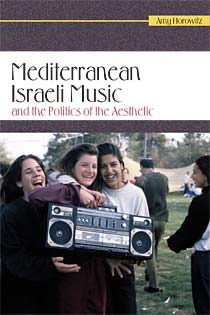
Musiqa mizrahit, aka Israeli Mediterranean Music, is a category of popular music mostly known for its strong Middle Eastern and Greek tinges. It has been at the center of Israeli public discourse on popular music since the late 1970s. By 2010, the leading theme of this discourse is the “triumph” of the genre in the field of Israeli popular music. With prominent performers such as Sarit Hadad, Eyal Golan, Kobi Peretz, Moshe Peretz, Shlomi Shabat, Lior Narkis and others filling up the largest music venues in Israel, leading the sale charts and ruling the radio airwaves, Israeli Mediterranean Music is by 2010 the “mainstream” of Israeli popular music. Throughout its history, speakers for Israeli Mediterranean Music have insisted, against their marginalization, that this genre is the “true” Israeli authentic popular music, the one that should be at center stage of Israeli culture. Given the genre’s success in the 1990s and the 2000s, Edwin Seroussi and myself concluded some years ago that “the nationalist impetus that underlined musiqa mizrahit for decades has achieved its own self-declared goal of both bringing musiqa mizrahit into the mainstream of Israeli popular music and of affecting the sounds of all popular music in Israel.”[1] Read the rest of this entry »
A Fine Romance: Jewish Songwriters, American Songs. David Lehman. New York: Nextbook/Schocken, 2009. 249 pp. ISBN 978-0-8052-4250-8
Creating America on Stage: How Jewish Composers and Lyricists Pioneered American Musical Theater. Jill Gold Wright. Saarbrücken, Germany: VDM Verlag Dr. Müller, 2009. 135 pp. ISBN 978-3-6391-7142-6
Reviewed by Larry Hamberlin
An ever-growing body of critical literature, beginning nearly forty years ago with Alec Wilder’s seminal American Popular Song, has established the lasting cultural value of the classic songs of George Gershwin, Jerome Kern, Irving Berlin, Richard Rodgers, and the other great songwriters of what is sometimes called popular music’s “golden era.”[1] (Whether or not one considers that era to have been “golden” has much to do with one’s opinion of rock and roll.) At the beginning of those decades—the 1920s through the 1950s—popular music was dominated by the sheet music publishing industry, centered on a few blocks of West 26th Street in New York City, an area that gave the business its nickname, Tin Pan Alley. But the era also saw the rise of radio and the growth of the recording and movie industries, mass media that eventually eclipsed sheet music as means of disseminating popular songs. The majority of hit songs throughout this period—and in contrast to later phases of popular music history—made their debut in Broadway and Hollywood musicals. Indeed, the history of the popular song in those years is inseparable from the history of the musical comedy. Read the rest of this entry »
Music in Terezín 1941-1945. Joža Karas. 2nd ed. Hillsdale, NY: Pendragon Press, 2009. ISBN 978-1-5764-7030-5
The Wonder and the Grace of Alice Sommer Herz: Everything is a Present. Dir. Christopher Nupen. DVD and Liner Notes. Allegro Films, 2009.
Reviewed by Shirli Gilbert
Shortly before his death in December 2008 Joža Karas completed the second edition of his book Music in Terezín 1941-1945, the culmination of a life’s work. When the book was originally published in 1985 it was path-breaking, documenting a largely unknown chapter in the history of the Holocaust: the lively and wide-ranging musical life in the “model ghetto” Terezín (in Czech, Theresienstadt in German). When Karas began his work as a “modest summer project” in 1970 (ix), very little music from the ghetto had been uncovered, and even less had been written about it. Karas, a Czech researcher and musician based in Connecticut, devoted the rest of his life to passionately researching the subject, conducting interviews across Europe, Israel, and the United States, undertaking archival research, and transcribing scores. In addition to publishing his book, he lectured widely on the subject, produced performing editions, and tirelessly promoted Terezín compositions in performances with his own string quartet, established expressly for that purpose. Karas himself conducted the American premiere of Brundibár in 1975 and the world premiere of the English version (in his own translation) in 1977. In short, the subject of music in Terezín has become well known among Western audiences thanks in large part to Karas’s pioneering efforts. Read the rest of this entry »
A Fusion of Traditions: Liturgical Music in the Copenhagen Synagogue. Jane Mink Rossen and Uri Sharvit. Odense: University Press of Southern Denmark, 2006. 156 pp. + supplemental CD. ISBN 978-8-7767-4038-2
Reviewed by Andrew Buckser
Jewish liturgical music presents a wonderful example of the way that local traditions emerge out of historical and political processes. Its content and style are often deliberately traditionalist, aiming to connect contemporary listeners to a history stretching back to the days of the prophets. That history is a complex one, however, involving thousands of years of migration, factionalism, and local variation, each of which have left their traces in the ethnic and cultural composition of any Jewish community. A Jewish service, especially a holiday service, contains a number of distinct musical events, and each of these requires a choice among the musical traditions associated with the different elements of the local community. In the music of its liturgy, therefore, every congregation literally sings out the unique fusion of traditions that make up its distinctive history. Read the rest of this entry »
Haydn’s Jews: Representation and Reception on the Operatic Stage. Caryl Clark. Cambridge: Cambridge University Press, 2009. ISBN 978-0-5214-5547-3
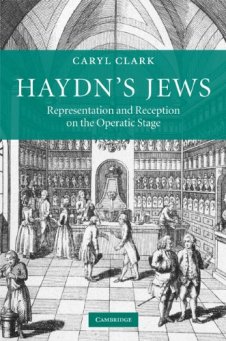
Reviewed by Jeanne Swack
Caryl Clark’s recent monograph on the subject of possible Jewish characterizations in Haydn’s music focuses on his opera Lo Speziale (The Apothecary), composed in 1768 to a libretto by the Venetian playwright Carlo Goldoni and first performed at the Esterhazy court for Haydn’s employer, the music-loving Prince Nikolaus I. The book’s principal contention is that the title character of this work, who is never identified as Jewish, nevertheless is an encoded representation of the typical “stage Jew” of the time, and would have been recognized as such by contemporary audiences. The argument for this reading is preceded by discussions of the Jewish communities in Haydn’s immediate environments in Vienna, Eisenstadt, and the Eszterháza estate, a discussion of stage Jews and previous characterizations of explicit Jewish characters in opera (citing my own work on Reinhard Keiser’s operas for the Hamburg stage in the early 18th century), a previous Singspiel in which Haydn seems to have portrayed a Jewish stereotype (but with no surviving music), and a discussion of a Haydn mass putatively aimed at Jews undergoing conversion to Catholicism.
Ignaz Friedman: Romantic Master Pianist. Allan Evans. Bloomington: Indiana University Press, 2009. 399 pp. ISBN 978-0-253-35310-8
 Reviewed by Jonathan D. Bellman
Familiar phrases like “Romantic Master Pianist” or the “Golden Age” of Romantic pianism (cf. an excellent recent book by Kenneth Hamilton[1]) are problematic, because they imply the existence of a single tradition shared by the giants of bygone eras. Rather, the greatest pianists of the past made their names by individuality, their independent artistic personalities and personal, often subjective interpretations of musical works that are now often normalized, more or less, into “the way this piece is played.” Foremost among these fiercely independent superpianists was Ignaz Friedman, a Polish-born Jewish virtuoso whose memory and recordings are revered by pianists but whose reputation has, unavoidably, faded somewhat. Although Friedman’s father was a peripatetic musician with limited skills at providing for his family, and his mother did most of the earning via needlework, their son’s prodigious musical gifts, which showed themselves early, were nonetheless never exploited commercially in his childhood. His family’s search for favorable circumstances meant that he would live in Poland, America, Greece, Turkey, Hungary, and Germany before going to Vienna for a university education and to complete his piano training with the renowned Theodor Leschetizky, who also trained a variety of other virtuosi. What all this meant was that Friedman would be among the best educated and most culturally well rounded of artists. Read the rest of this entry »
Jewish Music and Modernity. Philip V. Bohlman. New York: Oxford University Press/AMS Studies in Music, 2008. xxxiii + 280 pp. ISBN 978-0-1951-7832-6
Reviewed by Lisa Parkes
Discourse about “Jewish music” has traditionally raised complex questions about the identity of “Jewishness” in music. The ontology of “Jewish music” in modern Jewish history is as elusive as the nature of music itself. The reason for this, as Philip Bohlman argues in Jewish Music and Modernity, is that Jewish music in modernity exists not within a definable space or time, but rather at moments of disjuncture – in between regions, amid moments of transition and transformation, and at the border of ethnic, religious, and social boundaries. Jewish music, as an aesthetically autonomous object in Jewish society, was conceived of for the first time at the modernist moment, when Jews entered the public sphere of modern European society, broadening the purely ritualized devotional function that music formerly served. But the structural transformation that modernity brought about in musical culture had the paradoxical effect of confounding the very notion of “Jewish” music. Exposed to modern musical practices and genres in the non-Jewish public sphere during a period of political and aesthetic transformation, Jewish music became “Jewish” precisely in its confrontation with non-Jewish genres, forms, languages, and performers. Bohlman demonstrates that Jewish music, in responding to the political and aesthetic challenges of modernity, is inherently hybrid, unstable, and dynamic. It represents a dynamic site where national, ethnic, and gender identities are constructed and contested. Thus, borders between Jewish and non-Jewish became permeable, so that “musical repertories that for some were entirely Jewish—say, cabaret at the turn of the twentieth century—were not the least bit Jewish for others” (xvii). In other words, music participated in the transformation of modern Jewish identity itself.
Read the rest of this entry »
Maqam and Liturgy: Ritual, Music, and Aesthetics of Syrian Jews in Brooklyn. Mark L. Kligman. Detroit: Wayne State University Press, 2009. 267 pp. + CD. ISBN 978-0-8143-3216-0
Reviewed by Galeet Dardashti
During my public lecturing on Judeo-Arab liturgical music, I often play recordings. Invariably, after hearing the thoroughly Arab sounds—sounds that, for many attendees, evoke images of the Muslim muezzin’s call to prayer—someone in the audience asks, “What is Jewish about this music?” Mark Kligman artfully answers this question in his comprehensive study of the Judeo-Arab synthesis between the music and text of the Shabbat liturgy of Syrian Jews living in Brooklyn. The author endeavors to provide a descriptive analysis of the Sabbath liturgy as well as a cultural lens for understanding Syrian Jewish identity (11). The Aleppo Syrian Jews of both Brooklyn and Israel are known for their appreciation and punctilious maintenance of the Arab maqam—traditional Arabic music’s system of melodic modes—in their liturgy. While other studies have examined other aspects of Syrian Jewish liturgy, Kligman’s is the first to document and analyze Syrian musical practices in the Sabbath service. Read the rest of this entry »

 Musica Judaica Online Reviews