
You are currently browsing the category archive for the ‘Book Review’ category.
Hitler’s Twilight of the Gods: Music and the Orchestration of War and Genocide in Europe. Alexandra Birch. Toronto: University of Toronto Press. 2025.
Reviewed by Kathryn Huether

Alexandra Birch’s Hitler’s Twilight of the Gods: Music and the Orchestration of War and Genocide in Europe presents the reader with a dramatic conceit: a Wagnerian scaffolding that traces the role of music and sound in the Nazi project from its rise (“Das Reichgold”) to its collapse (“Trauermusik”). “This is not exclusively a study of Jewish victimhood or of German perpetration,” Birch writes, “but a more nuanced understanding of expanded victim categories, shades of perpetration, the complicated role of bystanders, the archive itself, masculinities, and the Holocaust, and the soundscape of genocide” (9).
Read the rest of this entry »From the Bronx to the Bosphorus: Klezmer and Other Displaced Musics of New York. Walter Zev Feldman. New York: Fordham University Press. 2025.
Reviewed by Yale Strom

Walter Zev Feldman’s From the Bronx to the Bosphorus (2025) is a hybrid work of memoir and cultural history that documents both the author’s personal trajectory and the diasporic musical traditions that shaped his career as a performer and scholar. The book does not conform to the structure of a conventional academic monograph; instead, Feldman weaves a richly layered narrative tracing his family roots, his musical education, and the many diasporic traditions he encountered in New York from the 1950s through the 1990s. During this period, immigrant cafés, clubs, and social gatherings served as vital spaces for the transmission of traditional repertoires, and Feldman positions himself as both participant and chronicler in this world.
Read the rest of this entry »Sounds of Survival: Polish Music and the Holocaust. J. Mackenzie Pierce. Berkeley: University of California Press. 2025.
Reviewed by Nicolette van den Bogerd
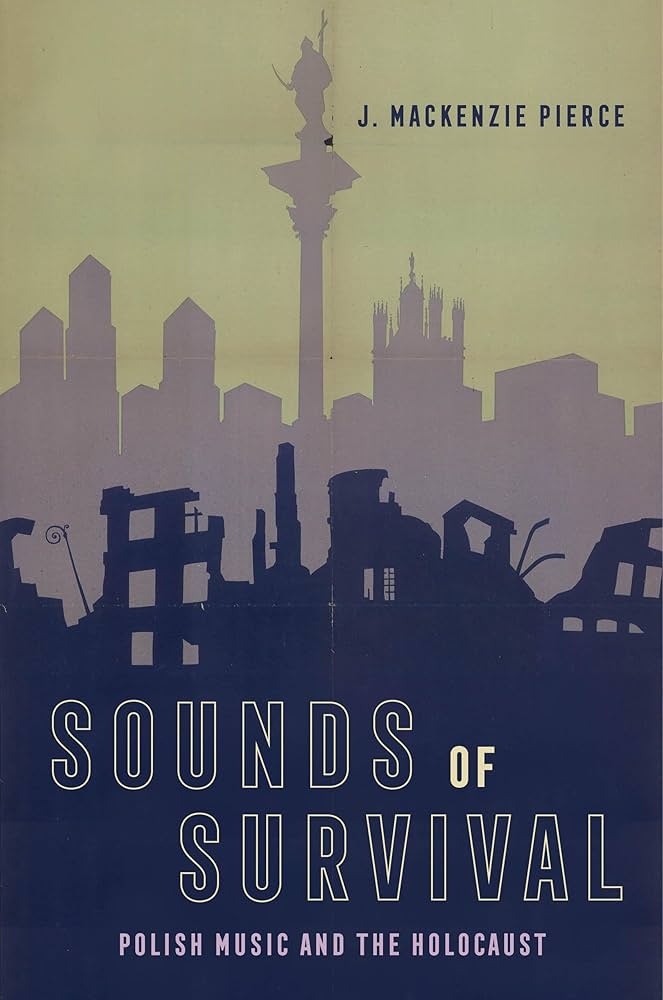
J. Mackenzie Pierce’s monograph Sounds of Survival: Polish Music and the Holocaust offers an in-depth examination of the social and political forces that shaped musical life in Poland from the 1920s through the early 1950s. Central to Pierce’s inquiry is uncovering how and why musicians, scholars, and critics who were active during these decades viewed Polish music during the Holocaust not as a rupture in the cultural development of the nation but rather as a marker of progress and continuity that continued to build into the postwar period. By reconstructing the lives and activities of Poland’s musical community, both at home and abroad, Pierce shows how a generation of musicians and scholars formed a “musical intelligentsia” that adopted narratives of continuity to reinforce a collective sense of identity and cultural resilience in the face of war trauma. However, Pierce also argues that this process of cultural reinvention marginalized Poland’s Jewish musicians, who, despite their longstanding contributions to Polish musical life, were largely excluded from these constructions of national identity.
Read the rest of this entry »Leone Sinigaglia 1868-1944: Spoliazione e Morte di un Compositore Ebreo Perseguitato dal Fascismo. Marco Fiorentino. Turin: Italy. Silvio Zamorani Editore. 2024.
Reviewed by Jesse Rosenberg

In the early twentieth century the Turinese composer Leone Sinigaglia reached a measure of popularity inside and outside of Italy mainly on the strength of a handful of instrumental works. He was also identified with research into folk songs of his native Piedmont region, which he came to know “from the mouth of the people” (as he claimed in the dedication of his folk song collection Vecchie Canzoni Popolar del Piemonte) during excursions into the countryside, and of which he published a number of arrangements. But the days when works such as his concert overture Le Baruffe Chiozzotte appeared on concert programs and radio broadcasts are long gone. In recent years the music of Sinigaglia has undergone a reappraisal, and a fair selection of his works has been recorded. A modest-sized monograph devoted to Sinigaglia appeared in 2012. [1] The reasons for this are not exclusively musical. The proportion is impossible to quantify with any precision, but at least part of this renewed interest is the fact that Sinigaglia was a victim of the Holocaust.
Read the rest of this entry »The Moralization of Jewish Heritage in Germany: Sustaining Jewish Life in the Twenty-First Century. Sarah M. Ross. Lanham, MD: Lexington Books. 2024.
Reviewed by Kira Álvarez

Many Germans today regard the preservation of Jewish heritage as a moral responsibility. In The Moralization of Jewish Heritage in Germany: Sustaining Jewish Life in the Twenty-First Century, German ethnomusicologist Sarah M. Ross examines how this responsibility has been addressed. She does this by exploring German Reform and Minhag Ashkenaz synagogue music, examining the roles of both Jewish and non-Jewish stakeholders in contemporary Germany. She highlights the creation of a “community of shared values” based on moral responsibility and feelings of belonging. However, Ross demonstrates that these shared values often reveal more about non-Jewish German society than Jewish society. She argues that Germany’s devotion to moralizing Jewish heritage often leads to an overly static understanding of Judaism and Jewish life, influenced by its Christian surroundings and largely confined to the past. Ross brings new insights to the topic of Jewish heritage in Germany, often regarded as a subject already comprehensively researched. She offers a perspective that is both original and urgent for our current times.
Read the rest of this entry »Time’s Echo: The Second World War, the Holocaust, and the Music of Remembrance. Jeremy Eichler. New York, NY: Alfred A. Knopf. 2023.
Reviewed by Karen Painter

Jeremy Eichler makes a passionate case that as we approach a world without living memory of the Holocaust, there is an “ethical imperative” to attend to “musical memorials” which summon “our commitment to witness” (pp. 174–175). Written when Eichler was classical music critic for the Boston Globe, Time’s Echo bears the fruits of his profession everywhere in eloquent and astute description of music that matters deeply to him. A historian who wrote his dissertation on Schoenberg’s A Survivor from Warsaw, Eichler undertakes the ambitious task of showing how music became so important to German Jews, which finds him starting his story in the Enlightenment, tracing the ideal of Bildung (cultivation) across Central European history. The book’s subtitle notwithstanding, we arrive at World War II only in chapter four out of ten.
Read the rest of this entry »56 New Klezmer Tunes for Dancing, Volume 1. Composed by Nat Seelen. New Klezmer Studios. 2023.
Reviewed by Christina Crowder

Boston-based clarinetist, bandleader, and music educator Nat Seelen has published a volume of klezmer-inspired melodies titled 56 New Klezmer Tunes for Dancing, Volume 1. The tunes are fresh and inventive, but the volume falls short in presenting tunes that could be used for Yiddish dancing. This may in part be attributed to the general revival-era decoupling of klezmer music intended for dancing from a living Jewish dance tradition as tunes were increasingly performed on the concert stage rather than mutual aid society balls or weddings. On the other hand, the 2010s brought a number of important resources online for performers and composers, including: a growing body of historical and musicological scholarship on klezmer dance music; [1] an ongoing effort within the klezmer community to teach both dance and playing for dancing; and, thousands of North American and European klezmer recordings now easily available online via the Mayrent Collection of Yiddish Recordings (University of Wisconsin, Madison), the Recorded Sound Archive (Florida Atlantic University, Boca Raton), YIVO, and other archives. While not all new klezmer compositions need to fit squarely within the traditional dance genres, when departures such as Seelen’s are intentional it serves the audience and the community writ-large to share their reasoning in notes on individual tunes or in introductory remarks. Because the folio presents the tunes specifically as dance music, this review will focus on structural analysis of tunes for danceability within the stated genre, and playability with regard to historically-informed klezmer practice in those genres rather than an evaluation of compositional issues.
Read the rest of this entry »Singing the Land: Hebrew Music and Early Zionism in America. Eli Sperling. Ann Arbor, MI: University of Michigan Press. 2024.
Reviewed by Inbar Shifrin

To a Jewish American, which anthem would hold greater importance: “The Star-Spangled Banner” or “HaTikvah?” According to Eli Sperling’s book Singing the Land: Hebrew Music and Early Zionism in America, the answer is both. One anthem affirms American patriotism, while the other represents a connection to Israel. This complex example illustrates the central question Sperling seeks to answer in his book: How did Hebrew songs play a role in fostering Zionism and a yearning for the land of Israel within American Jews without encouraging immigration to physically build Israel?
Read the rest of this entry »The Cambridge Companion to Jewish Music. Edited by Joshua S. Walden. Cambridge: Cambridge University Press. 2015.
Reviewed by Simone Salmon

By creating and editing The Cambridge Companion to Jewish Music, Joshua Walden addresses the question, “What is Jewish Music?” This volume includes Biblical Music, Liturgical Music, Music in Judeo-Spanish, Klezmer, Yiddish Theater, Haskalahic Synagogue Music, European Art Music, and Israeli Art Music. The topics covered are ontology, diaspora, hybridity, separation from source, musical reform, identity negotiations, and bi-directionality. The works included span the ancient, modern, and contemporary periods. The book contains three main sections: conceptions of Jewish music; Jewish music in religious, folk, and popular contexts; and periods, places, and genres of Jewish music composition.
Read the rest of this entry »Leonard Bernstein in Context. Edited by Elizabeth A. Wells. Cambridge: Cambridge University Press. 2024.
Reviewed by Zane Larson
Leonard Bernstein in Context, edited by Elizabeth A. Wells, is a new publication in the “Composers in Context” series from Cambridge University Press. It joins the company of texts covering canonical figures in the Western tradition such as Mozart, Mahler, and The Beatles. Thirty-six scholars examine wide-ranging topics in the cultural and political histories of Bernstein’s life and work, such as his Jewish upbringing, his involvement in civil rights, West Side Story, and his famed Young People’s Concerts. The collection provides readers with short and concise chapters attuned to the multi-faceted scholarly conversations surrounding Bernstein’s fame, well-documented life as a pianist, conductor, composer, educator, and cultural ambassador, and his ubiquity in musicological research.
Read the rest of this entry »
 Musica Judaica Online Reviews