
You are currently browsing musicajudaica’s articles.
Music in Terezín 1941-1945. Joža Karas. 2nd ed. Hillsdale, NY: Pendragon Press, 2009. ISBN 978-1-5764-7030-5
The Wonder and the Grace of Alice Sommer Herz: Everything is a Present. Dir. Christopher Nupen. DVD and Liner Notes. Allegro Films, 2009.
Reviewed by Shirli Gilbert
Shortly before his death in December 2008 Joža Karas completed the second edition of his book Music in Terezín 1941-1945, the culmination of a life’s work. When the book was originally published in 1985 it was path-breaking, documenting a largely unknown chapter in the history of the Holocaust: the lively and wide-ranging musical life in the “model ghetto” Terezín (in Czech, Theresienstadt in German). When Karas began his work as a “modest summer project” in 1970 (ix), very little music from the ghetto had been uncovered, and even less had been written about it. Karas, a Czech researcher and musician based in Connecticut, devoted the rest of his life to passionately researching the subject, conducting interviews across Europe, Israel, and the United States, undertaking archival research, and transcribing scores. In addition to publishing his book, he lectured widely on the subject, produced performing editions, and tirelessly promoted Terezín compositions in performances with his own string quartet, established expressly for that purpose. Karas himself conducted the American premiere of Brundibár in 1975 and the world premiere of the English version (in his own translation) in 1977. In short, the subject of music in Terezín has become well known among Western audiences thanks in large part to Karas’s pioneering efforts. Read the rest of this entry »
A Fusion of Traditions: Liturgical Music in the Copenhagen Synagogue. Jane Mink Rossen and Uri Sharvit. Odense: University Press of Southern Denmark, 2006. 156 pp. + supplemental CD. ISBN 978-8-7767-4038-2
Reviewed by Andrew Buckser
Jewish liturgical music presents a wonderful example of the way that local traditions emerge out of historical and political processes. Its content and style are often deliberately traditionalist, aiming to connect contemporary listeners to a history stretching back to the days of the prophets. That history is a complex one, however, involving thousands of years of migration, factionalism, and local variation, each of which have left their traces in the ethnic and cultural composition of any Jewish community. A Jewish service, especially a holiday service, contains a number of distinct musical events, and each of these requires a choice among the musical traditions associated with the different elements of the local community. In the music of its liturgy, therefore, every congregation literally sings out the unique fusion of traditions that make up its distinctive history. Read the rest of this entry »
Haydn’s Jews: Representation and Reception on the Operatic Stage. Caryl Clark. Cambridge: Cambridge University Press, 2009. ISBN 978-0-5214-5547-3
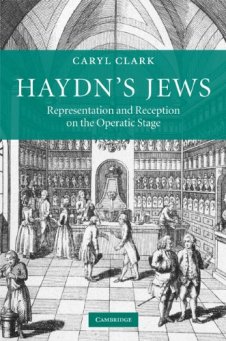
Reviewed by Jeanne Swack
Caryl Clark’s recent monograph on the subject of possible Jewish characterizations in Haydn’s music focuses on his opera Lo Speziale (The Apothecary), composed in 1768 to a libretto by the Venetian playwright Carlo Goldoni and first performed at the Esterhazy court for Haydn’s employer, the music-loving Prince Nikolaus I. The book’s principal contention is that the title character of this work, who is never identified as Jewish, nevertheless is an encoded representation of the typical “stage Jew” of the time, and would have been recognized as such by contemporary audiences. The argument for this reading is preceded by discussions of the Jewish communities in Haydn’s immediate environments in Vienna, Eisenstadt, and the Eszterháza estate, a discussion of stage Jews and previous characterizations of explicit Jewish characters in opera (citing my own work on Reinhard Keiser’s operas for the Hamburg stage in the early 18th century), a previous Singspiel in which Haydn seems to have portrayed a Jewish stereotype (but with no surviving music), and a discussion of a Haydn mass putatively aimed at Jews undergoing conversion to Catholicism.
Ignaz Friedman: Romantic Master Pianist. Allan Evans. Bloomington: Indiana University Press, 2009. 399 pp. ISBN 978-0-253-35310-8
 Reviewed by Jonathan D. Bellman
Familiar phrases like “Romantic Master Pianist” or the “Golden Age” of Romantic pianism (cf. an excellent recent book by Kenneth Hamilton[1]) are problematic, because they imply the existence of a single tradition shared by the giants of bygone eras. Rather, the greatest pianists of the past made their names by individuality, their independent artistic personalities and personal, often subjective interpretations of musical works that are now often normalized, more or less, into “the way this piece is played.” Foremost among these fiercely independent superpianists was Ignaz Friedman, a Polish-born Jewish virtuoso whose memory and recordings are revered by pianists but whose reputation has, unavoidably, faded somewhat. Although Friedman’s father was a peripatetic musician with limited skills at providing for his family, and his mother did most of the earning via needlework, their son’s prodigious musical gifts, which showed themselves early, were nonetheless never exploited commercially in his childhood. His family’s search for favorable circumstances meant that he would live in Poland, America, Greece, Turkey, Hungary, and Germany before going to Vienna for a university education and to complete his piano training with the renowned Theodor Leschetizky, who also trained a variety of other virtuosi. What all this meant was that Friedman would be among the best educated and most culturally well rounded of artists. Read the rest of this entry »

 Musica Judaica Online Reviews