
You are currently browsing musicajudaica’s articles.
For Women and Girls Only: Reshaping Jewish Orthodoxy Through the Arts in the Digital Age. Jessica Roda. New York, NY: New York University Press. 2024.
Reviewed by Miranda Crowdus

In this book, Jessica Roda explores a recently emergent phenomenon enabled to a large degree by the possibilities of the digital age. Roda explores Orthodox Jewish women’s musical and theatrical performances for women and by women, drawing on years of recent fieldwork including participant observation and in-depth interviews. Roda’s book is a holistic tour-de-force representing the networks, relationships, spaces and venues – human, digital, geospatial, and other – through which these performances are created, rehearsed, and broadcast. This investigation includes a sensitive and honest reflection on the author’s own positionality and enmeshment, not only within the communities and in relation to the individuals under focus but also more broadly to the state of belonging to the Jewish community and being a woman in North America in the twenty-first century. In these dense and detailed portrayals, the results of a wealth of engaged, detailed, and multifaceted fieldwork, the emergence of the kol isha (the voice of a woman) “industry” to its current proliferation, and rich descriptions of the women’s and others’ negotiations with halacha (Jewish law) are explored in detail. It should be noted that such negotiations are normative in Judaism across denominations. But, as the book clearly explains, what differentiates the Hasidic and Haredi communities is their adherence to the authority of the rebbe (or rabbi) in these negotiations.
Read the rest of this entry »Music of Exile: The Untold Story of the Composers Who Fled Hitler. Michael Haas. New Haven, CT: Yale University Press. 2023.
Reviewed by Dr. Alexandra Birch

Michael Haas’s new book is an expansion of his earlier work on Forbidden Music: The Composers Banned by the Nazis (Yale University Press: 2013) critically reconsidering different modalities of “exile” and the impact of exile on musical composition. Rather than a simple look at only those composers who fled to the United States, Haas engages with larger issues in the historiography of the Holocaust, like the material and financial ability to flee, the change in the perceived danger of Hitler across the 1930s, and how far was far enough to escape the war. Haas also complicates our understanding of those composers who remained in Europe, addressing the spectrum of complicity that they employed in order to continue working in occupied Europe. One of the strengths of the book is Haas’s experience both in performance and the humanities, where he elegantly puts the aesthetics of music in dialogue with Nazi racial and political strictures, emphasizing that denunciation and danger could be on both fronts with “Jewish” music and or a Jewish racial identity. The writing about music never feels cumbersome and is accessible to historians and musicians alike.
Read the rest of this entry »This Is Your Song Too: Phish and Contemporary Jewish Identity. Edited by Oren Kroll-Zeldin and Ariella Werden-Greenfield. University Park, PA: Penn State University Press. 2023.
Reviewed by Dr. Robert J Wuagneux

What is the connection between Phish and contemporary Jewish identity? Why does Phish have a disproportionately large Jewish fanbase? Editors Oren Kroll-Zeldin and Ariella Werden-Greenfield argue that the answer to these questions lies in a complex mosaic of religious and cultural ties that link Phish’s music and their fans’ complementary scene practices with Jewishness. Using a broad and inclusive understanding of Jewishness, this book counts all who identify as “Jewish” as Jews and all who identify as Phish fans as such.
Read the rest of this entry »Golden Ages: Hasidic Singers and Cantorial Revival in the Digital Era. Jeremiah Lockwood. Berkeley and Los Angeles, CA: University of California Press. 2024.
Reviewed by Matthew Austerklein
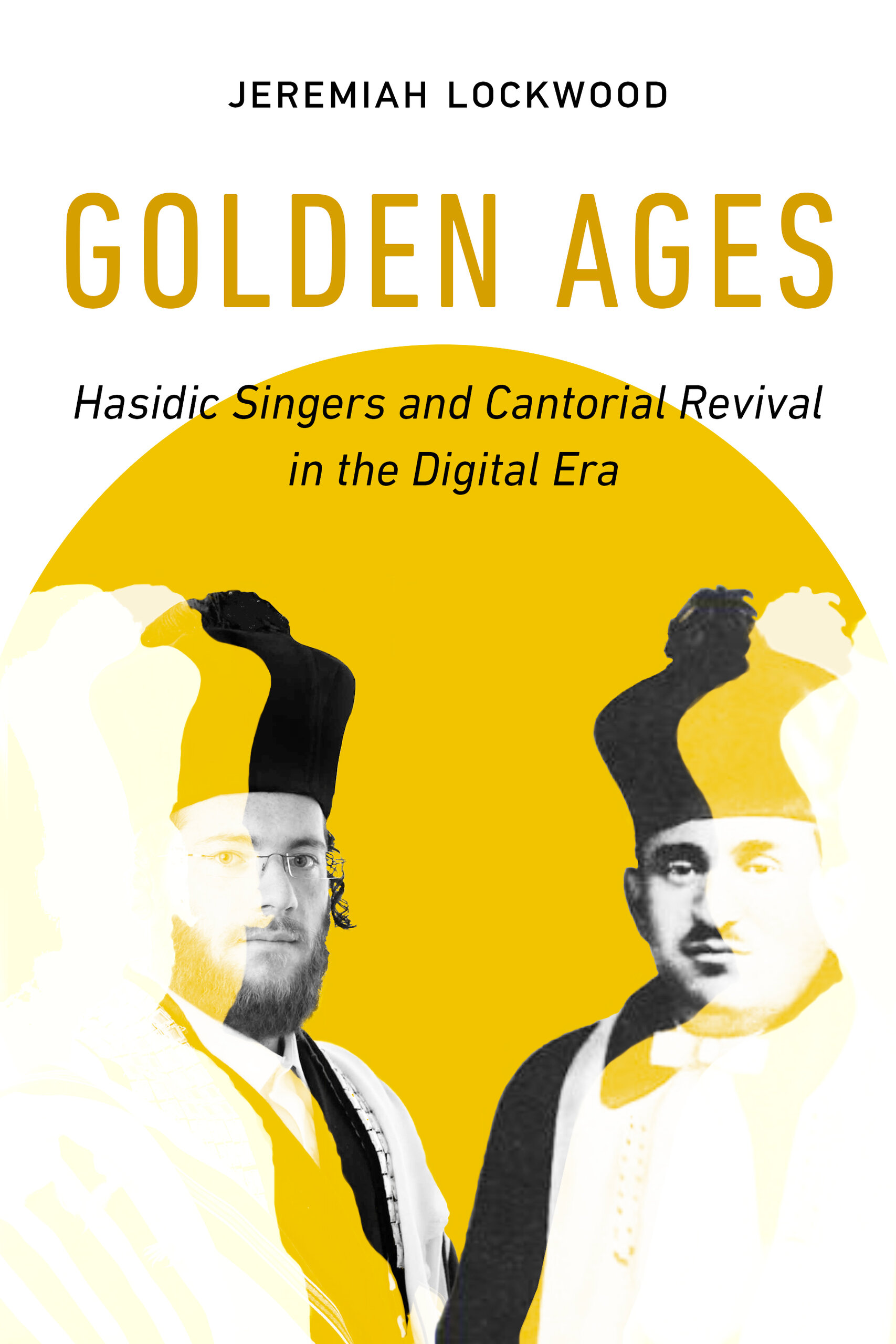
Jeremiah Lockwood’s new book, Golden Ages: Hasidic Singers & Cantorial Revival in the Digital Era (University of California Press, 2024) is the culminating work of a determined and thoughtful advocate of cantorial music. The grandson of Cantor Jacob Konigsberg, Lockwood is a scholar-activist with a long history of academic achievement and musical creativity [1]. This new work continues that trajectory, combining a thorough study of cantors with hints of an emerging musical ideology. At the center of his groundbreaking book are the stories of a small group of Hasidic singers in Brooklyn who are reviving Golden Age cantorial music through performance and recording, all while negotiating their countercultural love of this expressive art form within the skeptical world of Hasidic Judaism and the largely pop-music ethos of the Orthodox synagogues in which they serve.
Read the rest of this entry »La Memoria Cantata: A Survivor from Warsaw di Arnold Schönberg nell’Europa del dopoguerra. Joy H. Calico. Edizione italiana a cura di Paolo Dal Molin, traduzione di Silvia Albesano. Milan: Il Saggiatore. 2023.
Reviewed by Jesse Rosenberg

On the list of musical works inspired by the Shoah, Arnold Schoenberg’s A Survivor from Warsaw has long held a special status. The realistic description of a roundup of Jews in the Warsaw ghetto, the concluding choral Shema that constitutes one of the strongest testimonies of Schoenberg’s re-commitment to Judaism in the last two decades of his life, and the combination of advanced twelve-tone technique with Sprechstimme, one of the composer’s earliest innovations, unite to make a powerful impression on listeners to this day. In her 2014 monograph Arnold Schoenberg’s “A Survivor from Warsaw” in Postwar Europe, dedicated to the reception of this work, Joy H. Calico documents in detail the effect of this work on European critics and audiences, and subjects it to a thorough analysis.
Read the rest of this entry »Let Our Music Be Played: Italian Jewish Musicians and Composers under Fascism. Edited by Alessandro Carrieri and Annalisa Capristo. Cham, Switzerland: Palgrave Macmillan. 2021.
Reviewed by Jesse Rosenberg

The last twenty years have witnessed significant developments in scholarship concerning antisemitism in Italy during the ventennio, the twenty-year period of Fascist rule (1923-1943). Thanks to historians such as Michele Sarfatti and Giorgio Fabre, the benign view which had hitherto prevailed with regard to the antisemitic laws promulgated by the Fascist government in 1938 — that these were adapted without conviction, in adherence to the dictates of a new alliance with Germany, and represented an unexpected about-face in the treatment of Italian Jews — have been definitively rebutted. The editors of this superlative collection of essays are aware of these newly-acquired insights (one of them, Annalisa Capristo, has co-authored an important book with Fabre), but also, to judge by the variety of approaches taken by the contributors to the book, equally cognizant of the complexities involved in applying these lessons to the field of music.
Read the rest of this entry »Sounding Jewish in Berlin: Klezmer Music and the Contemporary City. Phil Alexander. Oxford: Oxford University Press. 2021.
Reviewed by Zeke Levine
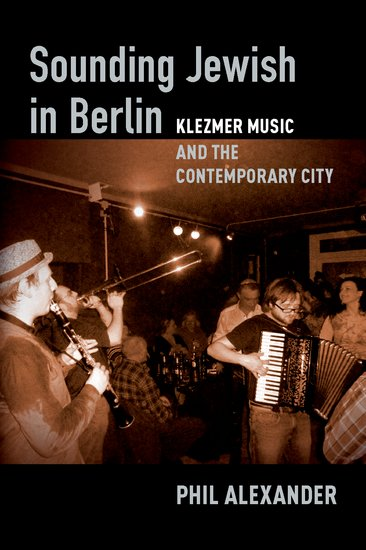
For the past two centuries, Berlin has maintained its role as a central crossroads of global politics, culture, and geography. The German capital is the focus of Phil Alexander’s Sounding Jewish in Berlin. Alexander probes the lively, yet complex contemporary Berlin klezmer scene, delving deeply into the ideological and aesthetic issues that shape it. While the klezmer revival has its roots in the United States, Alexander effectively and engagingly transports the reader to Berlin, an important locus for klezmer performance since the 1980s. Berlin, notes Alexander, is a complex setting for klezmer, given the city’s conflicted relationship with Jewish, particularly Eastern European Jewish, communities and folkways. Throughout the text, Alexander highlights thirty musicians and other creatives on the Berlin scene, framing the book around their experiences as well as his own extensive ethnographic experience as both a performer in, and keen observer of, the scene.
Read the rest of this entry »Jewishness, Jewish Identity and Music Culture in 19th-Century Europe. Ed. by Luca Lévi Sala. Bologna: Ut Orpheus. 2020.
Reviewed by Martha Stellmacher

The Enlightenment and the granting of civil rights to Jews in nineteenth-century Europe opened up new opportunities in society, and also in cultural and musical life. These processes were accompanied and reflected in the ongoing discussion of the so-called “Jewish question,” a debate in Jewish and non-Jewish circles concerning the understanding of Judaism and the status of Jews in the European societies. Though from the second half of the 19th century this term was increasingly used in antisemitic circles and finally taken up by the Nazis, it originally referred to a broad discussion on the political, national and legal position of a Jewish minority in a non-Jewish majority society. It partly touches in its nature upon aspects that we would call today “identity” —a term frequently used in the past decades to examine questions of belonging and self-understanding. Sala’s book assembles eleven studies touching upon many different aspects and layers of Jewish identity in the 19th century. These studies include the individual Jewish identity of certain composers and the expression of Jewish identity through music works up to the perception of Jews and Judaism by the gentile world.
Read the rest of this entry »Eastern Mediterranean Judeo-Spanish Songs from the EMI Archive Trust (1907-1912). Rivka Havassy and Edwin Seroussi. Jerusalem: Jewish Music Research Center, Hebrew University of Jerusalem. 2020.
Reviewed by Vanessa Paloma Elbaz

The EMI Archive Trust houses a collection of Jewish music from the Eastern Sephardim, originally released by Gramophone and Zonophone on 78 RPM between 1907 and 1912. This collection was released by the Jewish Music Research Center as a recording, with a physical CD and an online presence, including liner notes in English and Hebrew, song texts and their translations providing a wealth of material for this review. The collection includes songs in Judeo-Spanish, Hebrew, Turkish and Serbo-Croatian. Ladino selections are numerous, demonstrating the public presence of Ladino in Ottoman urban centers of this area at the time, despite the minority status of its community. The confluence of “the predominantly urban character of the late Ottoman Jewish society and its increasing middle class aspirations and leaning towards Westernization during the last decades of the Empire, coupled with the Jewish ethnicity of some key managerial figures of the European record companies, contributed to the presence of the song in Ladino in the early Eastern Mediterranean discography” (11-12). As was also the case with early Judeo-Arabic recordings, Jewish producers almost monopolized positions of local representation for international recording companies. This may have been partially due to the legacy of the Alliance Israelite Universelle’s training in French for Mediterranean Jews since the nineteenth century, which facilitated exchange and collaboration with European companies by the early twentieth century. Such collaboration allowed local musicians to create a dynamic market for the recording of Jewish artists and repertoires throughout the Ottoman empire and North Africa as recording technologies were developed and monetized. Another release (from 2008) from the JMRC in this broad category is focuses on Odeon’s recordings of Haim Effendi from 1907 in Turkey.
Read the rest of this entry »Musical Exodus: Al-Andalus and its Jewish Diasporas. Ruth Davis. Lanham MD: Rowman & Littlefield. 2015.
Reviewed by Samuel Torjman Thomas

The Iberian Peninsula has served as a focal point for enhancing our understanding of early modern racism, the age of nautical exploration, migration, memory, the advent of European colonialism, and perhaps most intensely as the site of interreligious intersectionality between Muslims, Jews, and Christians and its consequences. The notion of diaspora has informed the work of many scholars in the modern academy. A topic of great interest in fields such as cultural anthropology and ethnomusicology, and even its own field, Diaspora Studies, diaspora has also long been a bedrock topic for Jewish studies. In this edited volume, Musical Exodus: Al-Andalus and its Jewish Diasporas, we find valuable contributions to discourses about Iberian history, Jewish culture, diaspora, and musical development.
Within this edited volume, we find a close analysis of the dynamics involved in several animating factors of the Sephardi diaspora, including schism, exile, mass emigration, resettlement, intraethnic synthesis, postmodernist imaginaries, and transnationalism. The title suggests a pluralization of the Sephardi diaspora, as an experience that perhaps informs an array of diasporas. We are encouraged to consider this community’s experience of collective identity development as multitudinal, touching several disparate geographical centers and moments on a timeline that stretches over five centuries. Through the included chapters and their focus on a field of expressive culture (music), we can better appreciate how the Jewish experience of diaspora involves much more than the reinforcement of some overarching and monolithic transnational community. We learn how the dynamics of the Jewish diaspora experience provide the necessary context for new transnational layers to emerge. While fraught on so many levels and in so many ways, these dynamics are reconceived in this book and represented as the location of the endurance of expressive culture. Music serves as the vehicle of choice here, as a means of navigating the emergence and realization of these new diasporic Jewish identities rooted in reproducing vibrant and vital connections to a Sephardi (Andalusian) homeland. [1]
Read the rest of this entry »
 Musica Judaica Online Reviews