
Sounds of Survival: Polish Music and the Holocaust. J. Mackenzie Pierce. Berkeley: University of California Press. 2025.
Reviewed by Nicolette van den Bogerd
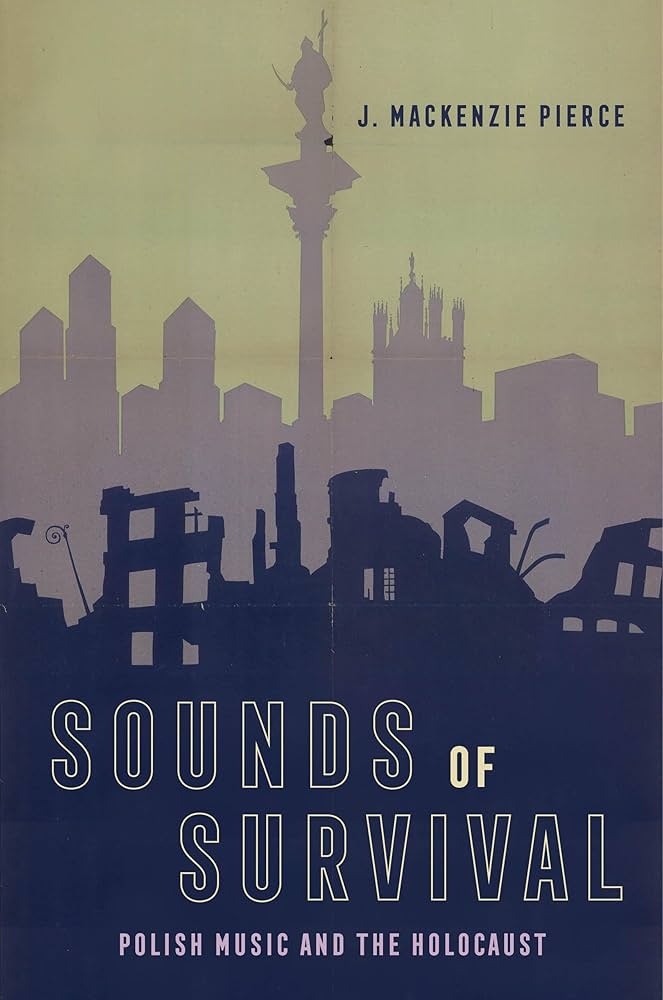
J. Mackenzie Pierce’s monograph Sounds of Survival: Polish Music and the Holocaust offers an in-depth examination of the social and political forces that shaped musical life in Poland from the 1920s through the early 1950s. Central to Pierce’s inquiry is uncovering how and why musicians, scholars, and critics who were active during these decades viewed Polish music during the Holocaust not as a rupture in the cultural development of the nation but rather as a marker of progress and continuity that continued to build into the postwar period. By reconstructing the lives and activities of Poland’s musical community, both at home and abroad, Pierce shows how a generation of musicians and scholars formed a “musical intelligentsia” that adopted narratives of continuity to reinforce a collective sense of identity and cultural resilience in the face of war trauma. However, Pierce also argues that this process of cultural reinvention marginalized Poland’s Jewish musicians, who, despite their longstanding contributions to Polish musical life, were largely excluded from these constructions of national identity.
Sounds of Survival is organized in three chronological parts. Part I, which has two chapters, examines the ideologies that connect music and musical institutions to the nation in the years before the Holocaust, as well as the role of antisemitism in these discourses. Chapter 1 focuses on the 1920s and 1930s, analyzing the emergence of a “musical intelligentsia” that assumed cultural authority in interwar Poland. This elite group, composed of both Jewish and non-Jewish musicians, sought to shape national identity through music after Poland regained its independence after World War I. However, as Pierce demonstrates, Jewish musicians were increasingly excluded from these national narratives. Chapter 2 examines the role of the musical intelligentsia within Poland’s cultural institutions, both at home and abroad, and how narratives of exclusion shaped these spaces. For example, Pierce examines antisemitic attitudes within the Association of Young Polish Musicians in Paris, where some questioned whether its Jewish members could effectively serve as Poland’s cultural ambassadors.
The three chapters in Part II explore how the “musical intelligentsia” navigated the years during the occupation and the Holocaust (1939–1945). Chapter 3 takes the reader to Nazi-occupied Warsaw and traces the activities of the non-Jewish members of the intelligentsia. Pierce demonstrates that, despite Nazi attempts to suppress Polish culture, musical activity persisted in small public venues around the city. While these activities were not without significant risk, the artists viewed themselves as keepers of Poland’s national musical identity in the face of cultural erasure. As Pierce argues, the idea that this was a period of musical growth both overlooks and diminishes the reality in which their Jewish colleagues found themselves in the nearby Warsaw Ghetto. In Chapter 4, Pierce shows that musical life also continued to develop behind the ghetto walls. The ghetto was home to several cultural establishments of various sizes that not only offered musicians a venue to continue cultivating their craft but also became spaces where they could renegotiate questions about their identities. As Pierce demonstrates, the realities of war forced this musical “ecosystem” into virtual isolation from the rest of Warsaw, despite its central position in an awkwardly demarcated part of the city [1]. While the activities the musicians engaged in were similar to those of their colleagues on the opposite side of the wall, the experience of living in an open-air prison inevitably shifted their goals and priorities in a different direction. In Chapter 5, Pierce explores musical life in Lviv (present-day Ukraine), that was first occupied by the Soviet Union in 1939 before Nazi Germany captured the city less than two years later. This so-called “double occupation,” Pierce argues, shaped local perspectives about the future of Polish music in a way that differed from elsewhere in the country [2]. For example, unlike the Nazis, Soviet authorities encouraged the development of Polish national music because it provided them an opportunity to infuse it with communist ideals. These ideals, as Pierce argues, were later foundational in how the musical intelligentsia articulated its goals during Poland’s early communist years after the Holocaust.
The chapters in Part III address Polish music in the postwar period after the country came under Communist leadership. In Chapter 6, Pierce examines the activities of the “musical intelligentsia” within the context of Poland’s early postwar reconstruction. Rebuilding Poland’s destroyed cities was as strenuous an undertaking as reconstructing its society after the war. Pierce chronicles how the country focused on building collective support for communism, and he shows that the “musical intelligentsia” adopted the framework of reconstruction to yet again reimagine the future of Poland and its music in this new political environment. While the overarching goal was to create national unity, Pierce shows how cultural tensions achieved the opposite result for Jewish musicians. Finally, Chapter 7 addresses the political concerns of the “musical intelligentsia” regarding the “aestheticization” of war trauma. Pierce argues that although some musical compositions memorialized the Jewish Holocaust experience, Poland’s “musical intelligentsia” aimed to commemorate the wartime past in a way that would not only express and advance their ideas about Polish music but would also fit within communist ideals. This resulted in compositions that foregrounded musical depictions of heroism, and even representations of Jewish suffering were re-contextualized to underscore themes of Jewish national resilience rather than victimhood.
The two appendices provide valuable supplementary material for readers seeking additional background on the many individuals and organizations within the “musical intelligentsia” that Pierce engages with throughout the book. The first appendix contains brief biographical sketches of twenty-seven key individuals that are central in Pierce’s narrative, many of whom are not generally well-known. The second appendix presents a comprehensive list of Polish musical and cultural institutions in Poland, along with short descriptions about each of their activities, intended audience, key individuals, and years of operation.
Sounds of Survival is a significant intervention in English-language research on twentieth-century music in Poland. It builds on previous scholarship on Polish music by offering new perspectives that not only illuminate the interconnected relationships between Jewish and non-Jewish musicians, but also show how dominant narratives of progress can obscure the experiences of those who suffered trauma [3]. Another key strength of the book is its broad geographical scope. By extending his focus beyond Warsaw, Pierce constructs a nuanced intellectual history of Polish music that should excite anyone who is interested in the topic.
J. Mackenzie Pierce’s Sounds of Survival stands out as one of the most compelling studies on the concerns of a generation of musicians in twentieth-century Poland. While some readers might prefer more in-depth musical analyses than the five examples that are featured, Pierce’s approach makes the book accessible not just to musicologists, but also to historians and other scholars across the humanities.
Nicolette van den Bogerd
[1] J. Mackenzie Pierce, Sounds of Survival: Polish Music and the Holocaust (Berkeley: University of California Press, 2025), 109.
[2] Ibid., 139.
[3] For more English-language scholarship on Polish music, see, for example: Lisa Cooper Vest, Awangarda: Tradition and Modernity in Postwar Music (Berkeley: University of California Press, 2020); Beata Bolesławska, The Symphony and Symphonic Thinking in Polish Music Since 1956 (New York: Routledge, 2019); and Lisa Jakelski, Making Music in Cold War Poland (Berkeley: University of California Press, 2016).

 Musica Judaica Online Reviews
Leave a comment
Comments feed for this article