
Leonard Bernstein in Context. Edited by Elizabeth A. Wells. Cambridge: Cambridge University Press. 2024.
Reviewed by Zane Larson
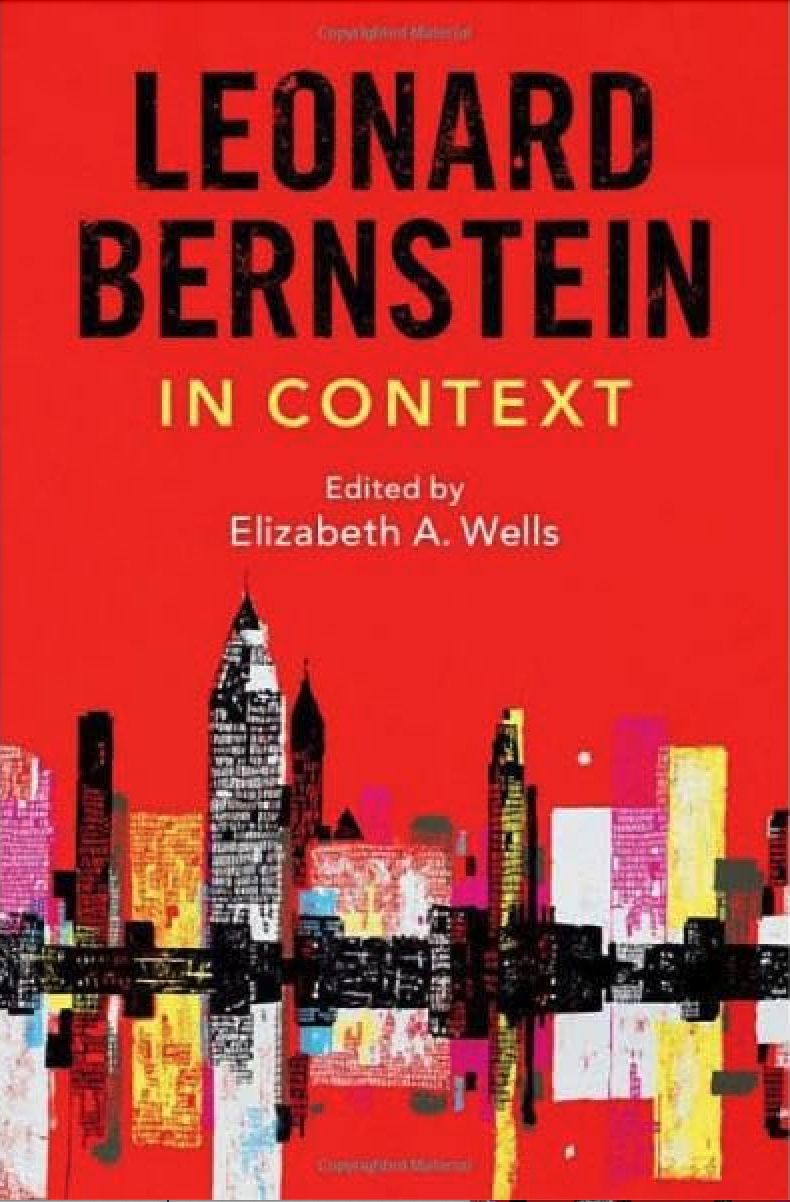
Leonard Bernstein in Context, edited by Elizabeth A. Wells, is a new publication in the “Composers in Context” series from Cambridge University Press. It joins the company of texts covering canonical figures in the Western tradition such as Mozart, Mahler, and The Beatles. Thirty-six scholars examine wide-ranging topics in the cultural and political histories of Bernstein’s life and work, such as his Jewish upbringing, his involvement in civil rights, West Side Story, and his famed Young People’s Concerts. The collection provides readers with short and concise chapters attuned to the multi-faceted scholarly conversations surrounding Bernstein’s fame, well-documented life as a pianist, conductor, composer, educator, and cultural ambassador, and his ubiquity in musicological research.
A major strength of this collection is the breadth of topics and research areas concerning Leonard Bernstein’s personal and professional life. The collection is split thematically into six parts totaling an impressive forty chapters. Part I investigates Bernstein’s world, including his education, Jewish influences, sexual and familial relationships, and involvement in sociopolitical movements in the United States. Part II examines Bernstein’s conducting career and explores ideas of his choreographed conducting movements and the intersections between his identities as conductor and performer. Part III expands on the compositional career of Bernstein and examines his influence on “American sound” and popular music while also providing context for the public and critical reception of themes explored in his works. Part IV surveys Bernstein’s activities as a cultural ambassador for both American music and classical music in American media and through his tours in Israel, the USSR, Asia, and Latin America. Part V maps the varied network of relations Bernstein had with prominent figures in his life such as Aaron Copland, Stephen Sondheim, and Jerome Robbins, exploring how these professional and personal relationships impacted his life and works. Finally, Part VI examines the legacy of Bernstein’s conducting, compositions, published recordings/writings, and archival documents at the Library of Congress and demonstrates how these contribute to his place as a cultural icon in American and music history.
Bernstein’s position as both celebrity and canonical musical figure place him at a curious intersection of scholarship that is as invested in his personal affairs as in his professional output, which is reflected by some topics covered in individual chapters. One aspect of this intersection that the collection focuses on is how Bernstein’s Jewishness was associated with both his personal and professional life. Part I contains two insightful chapters on Bernstein’s Jewish influences that highlight how his faith engaged with his personal and professional worlds. Chapter 2, by Ann Glazer Niren, discusses Bernstein’s upbringing in the Mishkan Tefila congregation in Brookline, Massachusetts, and how his connections to his Rabbi, cantor, and congregational music director greatly impacted his early musical training, providing more context for his early personal relationships to Jewish musicians and music. Furthermore, Chapter 3, by Mark Kligman, considers Bernstein’s “Jewishness” as part of his compositional practice and process, expanding on how Bernstein’s Jewish identity and upbringing impacted the compositional choices in his works. At first glance, these two chapters would seem to be the only ones that highlight Bernstein’s Jewish faith; however other chapters such as Chapter 11 “Crisis of Faith” (Part III), Chapter 23 “Israel” (Part IV), Chapter 33 “Marc Blitzstein” (Part V), and Chapter 34 “Composing Legacy” (Part VI), each contend with Bernstein’s Jewish heritage and influences in his compositional and conducting careers, further adding to our understanding of Bernstein’s engagement with Judaism in a wider array of contexts. In these chapters, the ideas of Bernstein’s personal and professional relationship with influences of Judaism are explored alongside his dual legacy as both celebrity and canonical musical figure in history. Contextualizing these intersections between his Jewish faith and his multiple personas can be beneficial for readers as they navigate further research.
Parts of this collection could be used in undergraduate and graduate courses on Jewish music, American music, or even in basic music appreciation courses. Some of the aforementioned chapters on Jewishness could be useful texts to instructors hoping to contextualize Bernstein’s approaches to composition in accordance with his Jewish influences. Furthermore, Bernstein’s Jewish upbringing could also be an interesting line of inquiry for students as they contextualize the role of formal music education within synagogues. When considering a course on American music, the collection offers a plethora of chapters with relevant themes that could be explored such as: Chapter 5 “Civil Rights, Activist, and Vietnam War Resister” (Part I), Chapter 6 “The Cold War, Democracy, and Hope” (Part I), Chapter 13 “American Sound” (Part III), Chapter 21 “Omnibus” (Part IV), Chapter 27 “Aaron Copland” (Part V) and Chapter 38 “The New York Philharmonic” (Part VI). The topical issues of Bernstein’s interactions with civil rights, nationalism in composition, and popular media in America provides instructors the opportunity to contextualize Bernstein in varied sociocultural histories. An instructor teaching a music appreciation class on influential musicians could group chapters based on gender and sexuality in Bernstein’s life to utilize the research and discussions in Chapter 4 “Sexuality, Relationships, and Family Life” (Part I), Chapter 16 “Women, Gender, and Sexuality” (Part III), Chapter 27 “Aaron Copland” (Part V), and Chapter 36 “The Library of Congress” (Part VI). Placing Bernstein in the contexts of social, cultural, and political histories of gender and sexuality can be useful for instructors as they navigate Bernstein’s contribution to academic and historical discourses with these inquiries. These tenable course ideas are just a smattering of the myriad opportunities available for educators who choose to use this text within their courses. While I view this text as highly accessible for undergraduate and graduate students, some of the chapters engage with music theoretical analysis as a methodology such as Chapter 10 “Conductor/Pianist,” Chapter 17 “Film,” and Chapter 30 “Kurt Weill.” If this text is used in a class for those who are not music students or trained in the Western classical tradition, they may not have the skills in reading musical notation needed for overall comprehension.
There are some noticeable gaps in conversations surrounding Bernstein’s relationships with women and his current cultural influence and relevance. For example, Bernstein’s marriage to Felicia Montealegre is mentioned but not expounded on. While she does appear as a minor focal point in Chapter 4, “Sexuality, Relationships, and Family Life,” in numerous other chapters, her name is often used in passing and not as a site of inquiry. Furthermore, despite the volume offering a section on his relationships, his personal and professional relationships with other women such as Shirley Gabis Rhoads Perle and Betty Comden are not as prevalent. While these individuals appear in other chapters, they are usually mentioned in passing. Moreover, there are some chapters about Bernstein’s legacy with musicians he nurtured, recordings he made, and writings he published that round out the collection; however, these chapters do not speak as much to how he appears in popular culture and media today or his relevance within concert halls and universities across the globe.
Leonard Bernstein in Context is a beneficial text for its versatile utility, expansive range of topics, and contribution to accessible research in Bernstein studies. While many works of scholarship attuned to Bernstein focus on broader biography or specific facets of his life such as his works on Broadway or his collaborations with famed contemporaries, this edited volume’s wide-ranging approach of topics expands perspectives on Bernstein past biographical chronology and specific snapshots in time. This collection thus accomplishes its goal of contextualizing Bernstein’s life and works and gesturing toward larger implications within music, Jewish, and American histories. Furthermore, the spread of topics in this volume draw on interdisciplinary work from musicology, music theory, performance studies, cultural studies, and gender studies, working toward a more nuanced understanding of Bernstein’s legacies both past and present. Collating the vast fields of research in this concise yet varied manner adds to the ever-expanding literature on Leonard Bernstein in a meaningful way both as a reference text and as a starting point for scholars and aficionados who continually find innumerable ways to place Bernstein in the context of his musical and historical world. Scholars, educators, or casual readers can likely find at least a mention of something they are interested in learning more about, such as Bernstein’s sexuality, the critical reception of Trouble in Tahiti, or the inclusion of Latin rhythms in his compositions. While the examinations of these concepts are not inherently extensive, this text can serve as a concise starting point for more research. Additionally, supplementary resources provided by the footnotes and further reading resources from Wells and from the chapter authors can help to point readers toward their topics of inquiry not sufficiently covered by the collection.
Zane Larson, University of Iowa
Zane Larson is a PhD candidate in Musicology at the University of Iowa where he specializes in research on musical theater, popular music, film music, and gender and sexuality studies. Zane’s previous degrees are a Master’s in Music Theory from Florida State University and a Bachelor of Arts in Vocal Performance with a minor in Education from Luther College. To learn more about Zane’s research and publications please visit https://academicmusiciowa.sites.uiowa.edu/people/zane-larson.

 Musica Judaica Online Reviews
Leave a comment
Comments feed for this article