
Golden Ages: Hasidic Singers and Cantorial Revival in the Digital Era. Jeremiah Lockwood. Berkeley and Los Angeles, CA: University of California Press. 2024.
Reviewed by Matthew Austerklein
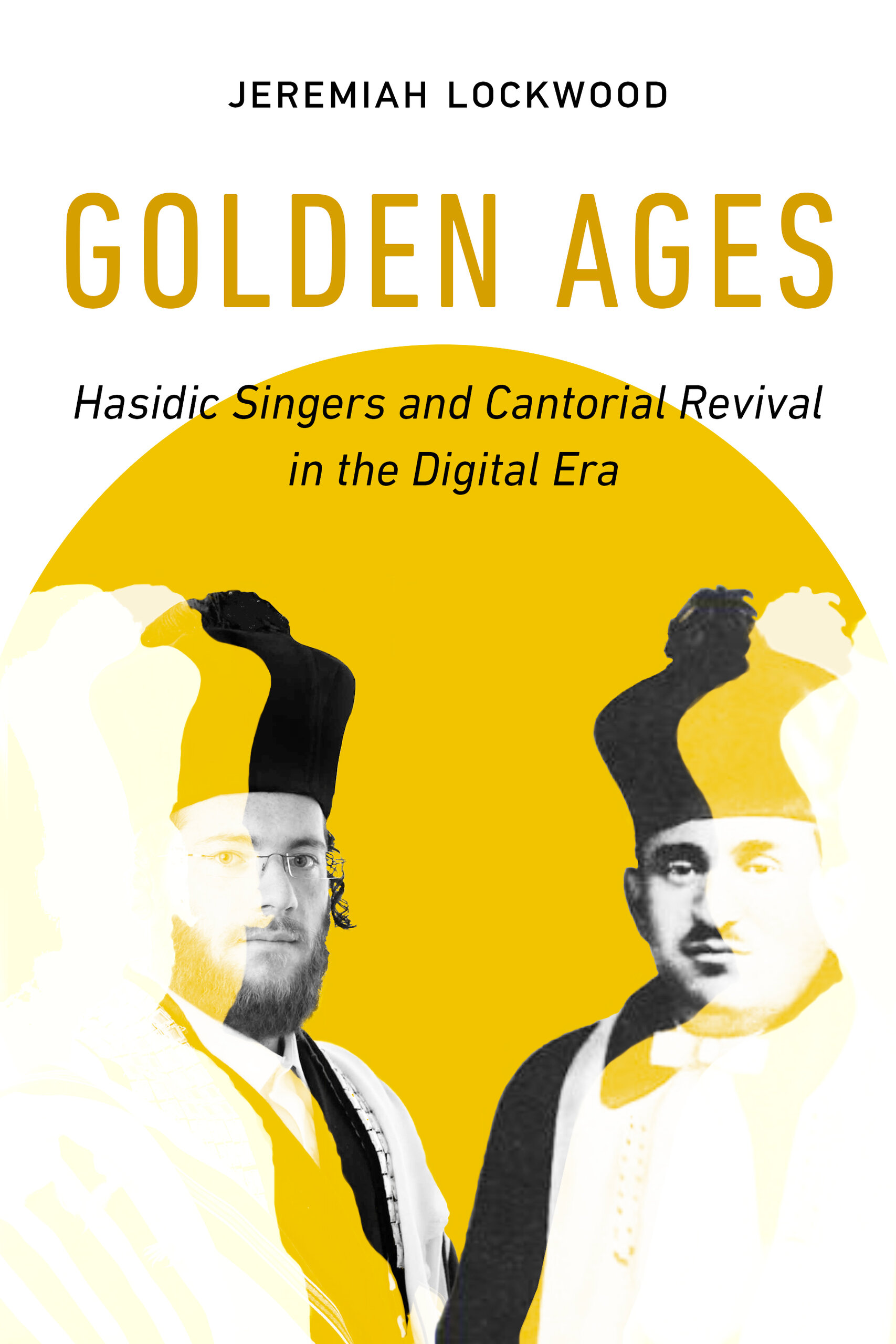
Jeremiah Lockwood’s new book, Golden Ages: Hasidic Singers & Cantorial Revival in the Digital Era (University of California Press, 2024) is the culminating work of a determined and thoughtful advocate of cantorial music. The grandson of Cantor Jacob Konigsberg, Lockwood is a scholar-activist with a long history of academic achievement and musical creativity [1]. This new work continues that trajectory, combining a thorough study of cantors with hints of an emerging musical ideology. At the center of his groundbreaking book are the stories of a small group of Hasidic singers in Brooklyn who are reviving Golden Age cantorial music through performance and recording, all while negotiating their countercultural love of this expressive art form within the skeptical world of Hasidic Judaism and the largely pop-music ethos of the Orthodox synagogues in which they serve.
While to liberal Jewish ears the world of chazonus may sound staid or conservative, Lockwood rightly situates the world of artistic cantorial music, both historically and contemporarily, as a countercultural movement. Both within Orthodoxy and in liberal Jewish circles, the rich early twentieth-century Ashkenazic cultural landscape that yielded this empire of sound has long since faded. Those that cling to the cultivated art form of chazonus thus run counter to the populist, contemporary genres that have overtaken the Jewish music world, including Orthodox pop / simcha music, niggunim, or guitar-accompanied prayer in the style of the American singer-songwriter.
Golden Ages is divided into four core chapters, broadly covering (1) cantorial sound recordings, both as they emerged in the Golden Age of Hazzanut and as re-animated today by cantorial revivalists; (2) a history and ethnography of cantorial pedagogy and nusach; (3) the rewards and constraints of pulpit life; and (4) modern opportunities for cantorial performance and self-actualization via kumsitzes (informal singing circles), online videos, and the concert stage. These chapters are interlaced with three ethnographic “interludes” illuminating the life stories and artistic pursuits of Lockwood’s Hasidic cantorial subjects, as well as their individual approaches to the tasks, contexts, and stakes of cantorial revivalism. Each chapter of Golden Ages represents not only a thorough academic intervention in the dynamics of cantorial artistry, but also a wide-ranging treatise on the essence of Jewish expressive culture, revealing in each seam the threads of an unfolding vision for cantorial revival that aspires to possess and transform the bodies of the Jewish people as part of an unrealized cultural redemption and aesthetic eschaton.
The stakes of the book are thus incredibly high. As an ethnographer, Lockwood faces the challenge of participant-observation, seeking to be an impartial and truth-seeking scholar while simultaneously honoring the stories and commitments of these cantors for whom he has been a fan, friend, collaborator, and producer. Lockwood balances this academic orientation with ample self-awareness of his utopian ideals for chazonus, the countercultural genre which runs through his blood as an artist and a cantor’s grandson, and which is the philosophical nusach giving both musical and ideological shape to his life. The author succeeds admirably at both of these goals.
What may strike the reader in Chapter One are the sensitive hearts of Lockwood’s cantorial subjects, including Hasidic cantors Yanky & Shulem Lemmer, Shimmy Miller, and Yoel Kohn. The strictures of Hasidic Judaism allow few outlets for creative personalities, and Lockwood reports empathetically on how chazonus serves as a sacred container of feeling and expression for sensitive youths and future cantors. This reveals a world of pious-presenting Hasidic cantors driven to create from a desire for personal fulfillment, and not largely (or in some cases, not at all) for religious reasons. As Lockwood discovered with humanizing self-awareness and perspicacity, these cantors sought out chazonuson on their own terms, claiming “the right to pursue abstraction and pure aesthetics” without requiring reference to their group identity. This first chapter further outlines the dynamic and often transgressive history of the Golden Age of Hazzanut, expanding on Lockwood’s earlier work on the battles between cantorial superstars and conservative cantors like Pinchas Minkovsky and Elias Zaludkowsky. This latter group castigated Golden Age artists for their commercial recordings and populist, even vulgar performance choices, desacralizing and degrading their sacred art outside of the synagogue.
Cantors of all denominations reading this book will likely identify with its third chapter, “Cantors at the Pulpit: The Limits of Revivalist Aesthetics.” Here, Lockwood describes how Hasidic cantors must adapt and “code-switch” into the pop-music and congregational singing ethos of today’s Orthodox synagogues. Orthodox pop developed its distinctive style in the twentieth century with singers like Mordechai Ben David, Avraham Fried, and Rabbi Shlomo Carlebach, and dominates the musical ethos of the Orthodox world. Lockwood thus explores the nonconformist, countercultural, and even morally suspect nature of Golden Age cantorial music in these pop-driven environments. Like all cantors, these Hasidic cantors must bend and compromise their artistic passions and personal fulfillment in order to do “was der publik will” (what the people want).
The book’s final chapter (“Conclusion: Cantors and their Ghosts”) is where Lockwood ponders the future implications and unfolding dreams of this cantorial revivalism, in a rich coda suggesting the outlines of a cantorial manifesto. One can feel Lockwood’s redemptive vision for a revived cultural empire of chazonus — mimetic and pluralist; celebrating women, minorities, and other marginalized groups; drawing upon multiple artistic and ideological lineages marshaled in the construction of identity; and musically transforming Jewish bodies into critical, if not radical others within an emerging post-Ashkenazic utopia.
Lockwood’s description of the foils of this vision — the professional cantorate — is the one part of his magnum opus that strums chords with questionable historical harmonies. As a phenomenologist of expressive and nonconformist art, Lockwood depicts with colorful and critical prose the institutions of the American cantorate, as well as the forefather of the modern cantorate, the Viennese modernizer Salomon Sulzer (1805-1890). Yet these depictions often come with historical omissions that more easily allow these institutional figures to play the role of “the Man”— the bourgeois champions of cantorial respectability and formalism against which rock-star cantors of all Golden Ages must authentically and rightfully rebel.
The real story is more subtle and elucidating. Salomon Sulzer, though a commanding force in the professionalization of the modern cantorate, was also a nonconforming musical populist — composing art songs and patriotic anthems for the Austrian public, secretly performing Schubert Lieder for decades following a congregational ban, and developing a public image as an eccentric equestrian. The twentieth-century cantorial schools and unions that arose to domesticate the cantorate were not simply agents of gelding the Golden Age cantorial id for “respectable” synagogue life, but were “big tents” of ideological and aesthetic commitments, ranging from Eastern European conservative traditionalists to reformers advocating significant aesthetic modernization based on American and Israeli national cultures.
For Lockwood, the nationalist tendencies of such institutional cantors and their Sulzerian ancestors run against the grain of the subversive, sonic otherness of the Golden Age revivalist paradigm that fills the human ear with embodied experiences of cultural alterity. Lockwood relies on the aesthetic multitudes inherent in chazonus itself, which broadly encompasses folk music, entertainment, Lieder, opera, and Ashkenazi sacred chant. But the institutional cantorate’s additional commitment to European, American, and Israeli nationalist musical forms renders it unpalatable to Lockwood’s project. As “the Man” of cantorial history, Lockwood presents the institutional and nationalist cantorate as a milquetoast source of alterity compared with the otherness of Golden Age cantorial sound.
Lockwood’s descriptions of the “cantorate” perhaps give more texture to broader models of cantorial leadership beyond the full-time pulpit model established by twentieth-century denominations. As Rachel Adelstein points out in her research on the Women Cantors Network, cantors have many textures of training via non-institutional models of apprenticeship and communal acclamation, as well as many models of work ranging from part- to full-time. [2] In re-centering the largely part-time cantorial vocations of the Hasidic world, Lockwood’s book is important for reconsidering models of cantorial leadership, particularly in our ever-shifting world.
Jeremiah’s Lockwood’s Golden Ages stands on its merits as the most insightful book about the dynamics of the cantorate and Jewish expressive culture since Mark Slobin’s Chosen Voices: The Story of the American Cantorate (1989). Its wide-ranging observations should cause a stir within Jewish musical circles, and especially within the cantorate itself. Cantors and cantorial enthusiasts of all types should surely pick up the book, which is free to read online, to see what they discover when they look in Lockwood’s empathetic mirror to the cantorial soul.
Matthew Austerklein is the Cantor of Temple Beth El in Rochester, NY and a PhD Candidate in Jewish Studies at Halle-Wittenberg University. His weekly newsletter on Jewish musicology, arts, and culture can be found at mattausterklein.substack.com.
[1] Jeremiah’s story, scholarship, and activism can be heard in this interview on Dr. Samantha Cooper’s Jewish musicology podcast, Sounding Jewish: https://rss.com/podcasts/soundingjewish/1381194/
[2] See Rachel Adelstein, “Voices Multiplied: Cantorial Tradition and Modernity in the Women Cantors’ Network,” Cantors Assembly 75th Anniversary Journal, ed. Matthew Austerklein (Akron: Cantors Assembly, 2022): 362-368.

 Musica Judaica Online Reviews
Leave a comment
Comments feed for this article